Blood Ammonia Tests in Dogs and Cats: How Handling Delays Change the Result
In unseparated blood, ammonia can rise within 30 minutes and read falsely high. Compare seven published handling clocks, in-clinic options and what to record before the draw.

The short answer
Blood ammonia is one of the most handling-sensitive tests a veterinary team can send. While blood sits unseparated, ammonia leaks out of red blood cells within about 30 minutes, and more is generated inside the tube from labile proteins and amino acids such as glutamine. A sample that waits on the bench or in a courier bag therefore tends to read falsely high. Cornell's eClinPath reference names delayed submission, delayed plasma separation and hemolysis as the most common cause of an increased ammonia result. That is the core problem: the handling error points in the same direction as the disease the test is looking for.
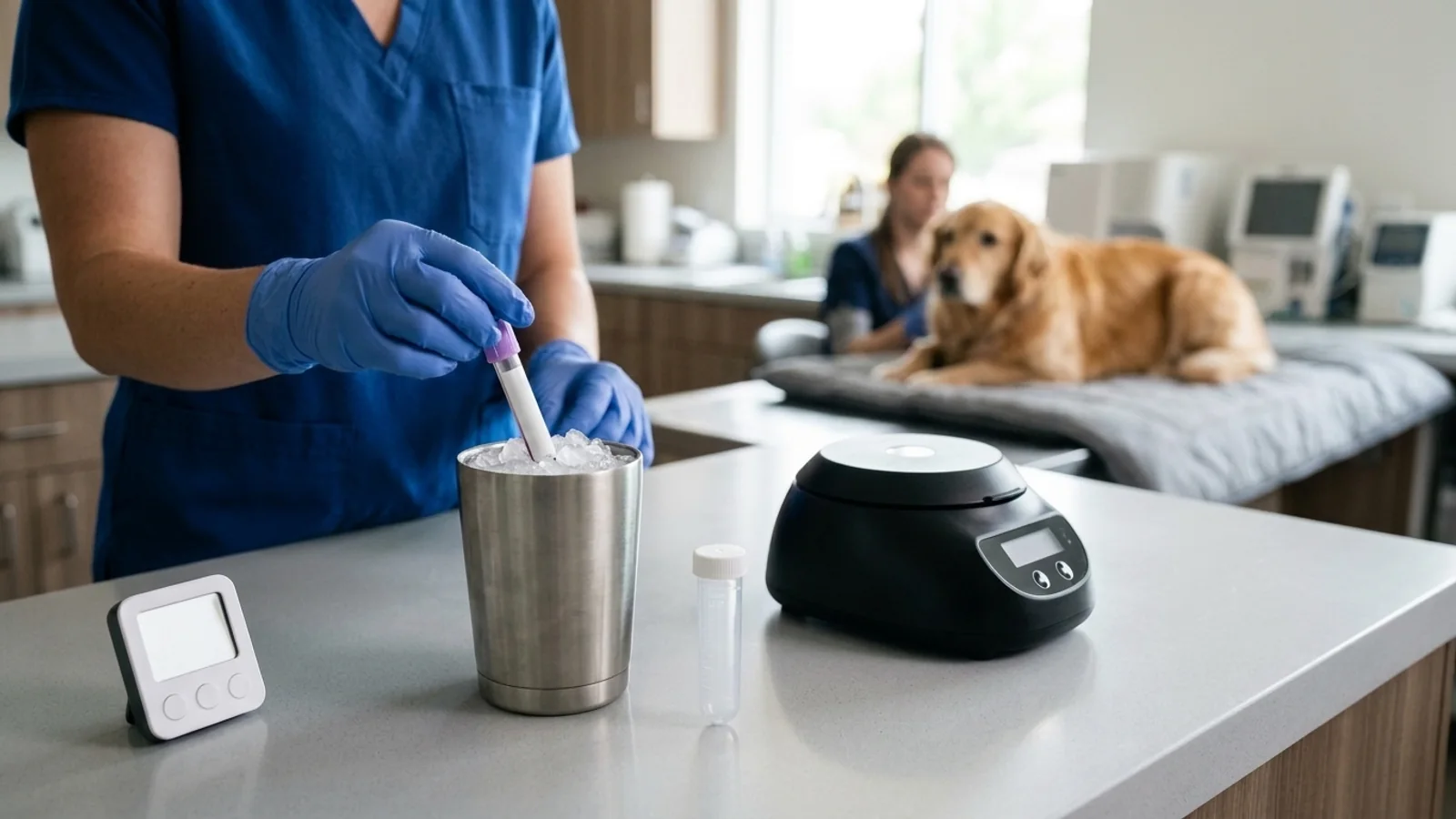
There is no single universal clock. eClinPath says to keep the tube on ice, separate the plasma within about 15 minutes and assay the chilled plasma within 3 hours. Oregon State University's diagnostic laboratory wants the sample delivered within 30 minutes, or the plasma separated, sealed on ice and delivered within 2 hours of collection. The Merck Veterinary Manual says samples should travel on melting ice and reach the analysis site within 20 minutes, and that they cannot be mailed. When a sample cannot be run in time, laboratories such as Cornell's ask for separated plasma frozen and shipped on dry ice, and Cornell adds a comment to the report if the sample arrives thawed.
The practical answer for owners and clinic teams: before the draw, confirm which laboratory or analyzer will run the test and follow that laboratory's current instructions for tube, ice, separation, freezing and transport. Write the timeline down, and let the veterinarian read the result together with it. When handling was compromised, the usual remedy is a fresh sample under the right clock, not an attempt to interpret around a suspect number.
Why ammonia cannot wait: the chemistry behind the clock
Ammonia comes mostly from protein breakdown, much of it generated in the intestines from food and from bacteria that split urea. Portal blood carries it to the liver, which converts most of it to urea; the Merck Veterinary Manual puts that direct detoxification at about 85%. When blood bypasses the liver through a shunt, or when a large share of liver function is lost, ammonia can build up in the bloodstream. That is why veterinarians measure it when they suspect abnormal portal blood flow or liver dysfunction, and in animals with neurologic signs. Shunt workup and treatment decisions are covered in our portosystemic shunt guide; this article stays with the sample.
Ammonia also answers a narrower question than other liver tests. Merck notes that ammonia is not influenced by cholestasis, whereas total serum bile acids also detect cholestatic disease. Awanui Veterinary describes ammonia as fairly specific but not very sensitive for severe liver disease. Liver enzymes on a routine chemistry panel and paired bile acid testing answer different questions and come with their own timing rules.
The clock exists because a tube of whole blood is still biologically active. eClinPath explains that ammonia leaks from erythrocytes within 30 minutes, and that the rise comes from ammonia generated from labile proteins and amino acids by both white and red blood cells. Cornell's submission page puts it plainly: ammonia rapidly increases with storage in whole blood and also increases with storage in separated plasma. Merck lists spontaneous generation of ammonia in samples not immediately cooled after collection, or not promptly analyzed, among the causes of spurious hyperammonemia. Cold and speed are the two levers every laboratory instruction in this guide relies on: chilling the tube and getting the plasma off the cells quickly.
The direction of that error is what makes it dangerous. eClinPath notes that only increased ammonia concentrations are diagnostically useful. A handling artifact that pushes the value up therefore produces exactly the kind of result a veterinarian is looking for. That is why the collection-to-analysis timeline is part of the result rather than a footnote to it.
What a delay actually does to the number
Most handling problems push the number up, but not all of them. The table below collects the effects described by the laboratories, manual and studies cited in this guide. It records direction only. None of these sources publishes a per-minute rate of rise for a sample left at room temperature, so there is no correction factor that turns a delayed result back into a true one.
| Handling or method problem | Usual effect on the reported value | Where it is described |
|---|---|---|
| Whole blood left unseparated | Falsely high; ammonia leaks from red cells within about 30 minutes | eClinPath; Awanui Veterinary |
| Sample not cooled immediately or not analyzed promptly | Falsely high, from spontaneous generation in the tube | Merck Veterinary Manual |
| Frozen sample that thaws in transit | May be falsely increased; accuracy cannot be assured | Cornell AHDC (report comment); eClinPath |
| Hemolysis | Falsely high; burst red cells release additional ammonia | eClinPath; IDEXX; Awanui Veterinary |
| Severe lipemia or icterus | May increase results on the method eClinPath describes | eClinPath; Awanui Veterinary |
| Serum instead of plasma | May read high, because ammonia is released during clotting | IDEXX; eClinPath prefers plasma |
| Ammonia from the room, water or hands (sweat, smoke, cleaners, open urine vials) | Falsely high, from contamination | Merck Veterinary Manual; eClinPath; IDEXX |
| Tube not completely filled or not stoppered | Falsely low, through loss of ammonia gas | eClinPath |
| Point-of-care meter with negative bias | Can read low enough to miss a high value | Goggs et al. 2008 |
Hemolysis deserves its own mention because it can happen during a difficult draw even when the clock is perfect. Our hemolyzed sample guide explains why a veterinarian may ask for another sample in that situation.
Separated and frozen plasma: what the small studies show
The research record adds a nuance about separated plasma, but it is thin. In a 1986 study, Hitt and Jones collected heparinized blood from 8 healthy dogs, placed it immediately in an ice-water bath, centrifuged it at 5 °C and measured plasma ammonia within 30 minutes. Aliquots were then stored at 21 °C, 4 °C, −15 °C or −40 °C and measured again at 24, 48 and 96 hours. The published abstract reports that statistical analysis did not indicate a significant relationship between each dog's initial plasma ammonia and the later determinations, and found no correlation or significance among samples stored at similar temperatures and times.
One reading of that result is that promptly separated, chilled canine plasma is more forgiving than unseparated whole blood, which fits the laboratories' emphasis on getting plasma off the cells quickly. It does not justify holding plasma longer than the performing laboratory allows. The abstract is brief, the dogs were healthy, there were only 8 of them, and the methods are four decades old. Cornell still states that ammonia increases with storage in separated plasma, and it caps chilled plasma at 3 hours.
Frozen storage is not a universal fix either, and it differs by species. Ogilvie and colleagues (1985) stored plasma at −20 °C from 13 cats and from 10 horses and a pony. Feline plasma ammonia did not change significantly after 48 hours, but it was 4.2-fold higher after 168 hours and 13-fold higher after 216 hours. Equine values rose significantly by 48 hours and were 25.6-fold higher at 168 hours. Urea nitrogen and bilirubin in the same samples stayed stable for at least 168 hours, so the instability was specific to ammonia, and the authors could not explain it. They concluded that feline plasma for ammonia may be stored at −20 °C for up to 48 hours.
eClinPath, by contrast, cites horse studies reporting ammonia stable for 21 days in frozen storage. The two horse findings conflict, and Ogilvie's study tested one freezer temperature in small groups of animals, so none of these results should be stretched from one species to another. For dogs and cats, the operative rule remains the performing laboratory's own instruction.
Named labs, different clocks: a collection-to-analysis timeline table
One reason ammonia handling causes confusion is that there is no single veterinary standard. Each laboratory or manufacturer publishes its own instructions, and they disagree on the tube, the separation deadline, how long chilled plasma may wait and whether to freeze straight away. The table compares seven published instruction sets as they read when we checked them on October 20, 2026. Most of these pages carry no revision date, so treat each row as that institution's instruction for its own service, not a rule for every laboratory.
| Source and setting | Tube or specimen | Chill and separate | Chilled-plasma window | If it cannot be run in time |
|---|---|---|---|---|
| Cornell AHDC (reference laboratory, New York) | EDTA or heparin tube | Separate immediately and keep plasma on ice; if separation is not possible, keep the sample on ice, but accuracy is reduced | Maximum of 3 hours on ice, for clients within a 1-hour drive | Separate immediately, freeze the plasma and ship on dry ice marked "PERISHABLE KEEP FROZEN"; a thawed arrival gets a report comment that the value may be falsely increased |
| eClinPath (Cornell teaching reference) | EDTA (purple top, preferred) or heparin (green top); plasma preferred to serum | Keep whole blood on ice; separate within 15 minutes (ideally) | Assay within 3 hours on ice or refrigerated | Freeze rapidly at −20 °C in a dedicated freezer; ship on enough dry ice that it cannot thaw; notify the laboratory so it can analyze within 1 hour of thawing |
| Oregon State University VDL (reference laboratory, test code 1003) | 0.5 mL heparinized plasma | Keep at 4 °C on ice; deliver within 30 minutes, or separate the plasma and keep it tightly sealed on ice | Deliver within 2 hours of collection | Move plasma off the red cells into an additive-free transport tube; ship overnight on cold packs or dry ice so it arrives frozen; if protocols are not followed, testing may not be possible |
| Iowa State University (clinical pathology specimen guide) | Heparinized green-top tube | Centrifuge immediately | None published; the guide says to freeze immediately | Aliquot the plasma into a capped plastic container and freeze immediately |
| Awanui Veterinary (commercial laboratory, New Zealand) | EDTA, kept on ice; patient fasted at least 8 hours | Separate within 15 minutes of collection | Assay within 2–3 hours on ice or at 4 °C | Freeze rapidly; ship on dry ice so it does not thaw; phone the laboratory before sampling |
| IDEXX Catalyst One guideline (in-clinic analyzer) | Lithium heparin whole blood; plasma only, because serum may read high | Centrifuge and separate immediately after collection; if there is any delay, cap the sample and put it on ice | Analyze immediately after separation | Not a shipping route; the guideline covers in-clinic analysis only |
| Merck Veterinary Manual (reference text) | Precooled tubes | Transport on melting ice | Reach the analysis site within 20 minutes | Samples cannot be mailed |
Read across the rows and the disagreements are plain. Tube choice varies: eClinPath prefers EDTA and Awanui uses it, Oregon State and Iowa State specify heparin, IDEXX specifies lithium heparin, and Cornell accepts either. The chilled window ranges from Merck's 20 minutes to Oregon State's 2 hours and Cornell's 3 hours, while Iowa State skips the chilled window and freezes at once. None of these pages explains its choice of anticoagulant, and this guide does not try to settle the differences. The tube and the clock that matter are the ones the performing laboratory asks for.
Two rows deserve a closer look. Awanui's instructions come with a caveat specific to New Zealand: it says no commercial veterinary laboratory there has a validated veterinary ammonia assay, so frozen EDTA plasma goes to medical laboratories and no veterinary reference interval is available. That arrangement should not be assumed elsewhere. Cornell's thawed-sample comment is the other. It shows a reference laboratory writing the handling risk onto the report itself, so the number and its caveat reach the veterinarian together.
Oregon State's directory entry also lists a fee of $87, testing Monday to Friday with a 1-day turnaround (same day when possible), and a STAT option at additional cost. Fees and schedules change, so check the current directory before relying on them.
flowchart TD
    A["Veterinarian orders blood ammonia"] --> B["Confirm the performing lab's current instructions: tube, ice, separation deadline, freezing, transport"]
    B --> C{"Where will the sample be analyzed?"}
    C -->|"In-clinic analyzer"| D["Follow the analyzer guideline, e.g. lithium heparin, separate and analyze immediately, cap and ice any delay"]
    C -->|"Reference lab reachable within its chilled window"| E["Keep on ice, separate by the lab's deadline, deliver within its window"]
    C -->|"Reference lab not reachable in time"| F["Separate, freeze rapidly, ship on dry ice so it cannot thaw, notify the lab"]
    D --> G["Record draw, ice, separation and analysis times"]
    E --> G
    F --> G
    G --> H{"Any step missed or sample thawed?"}
    H -->|"Yes"| I["Veterinarian decides whether to repeat the test"]
H -->|"No"| J["Veterinarian interprets the result with its timeline"]Frozen, iced, or run in-clinic: how the route changes the rules
Sending the sample to a reference laboratory
For a reference laboratory, the question is whether the sample can reach the analyzer inside that laboratory's chilled window. Cornell draws the line at roughly a 1-hour drive: local clients send separated plasma on ice, while mailed samples, or any that will not reach the laboratory within an hour, are frozen. The Merck Veterinary Manual is stricter. It says ammonia samples cannot be mailed for analysis at all, and that blood should travel on melting ice to the analysis site within 20 minutes.
Frozen submission has its own failure points. eClinPath asks for rapid freezing in a dedicated freezer at −20 °C, enough dry ice that the sample cannot thaw in transit, and a call ahead so the laboratory can run controls, calibrate its instrument and analyze the sample within an hour of thawing. It also recommends running control samples from a clinically healthy animal alongside patient samples, so that collection and handling can be ruled out as the cause of an elevation. Awanui adds timing advice of its own: collect in the morning, send the sample as soon as possible and phone the laboratory first, because overnight storage and long transport raise the risk of an inaccurate result.
Running the test on an in-clinic chemistry analyzer
In-clinic analysis removes the courier but not the clock. IDEXX's guideline for the Catalyst One analyzer asks for lithium heparin whole blood, centrifuged and separated immediately after collection, then analyzed immediately. If there is any delay between collection, centrifugation and analysis, the sample must be capped and placed on ice at once. The guideline recommends plasma only, because ammonia is released during clotting and serum may read high, and it warns against hemolyzed samples. Practices weighing an analyzer purchase can compare platforms in our in-house chemistry analyzer guide.
The same guideline treats the room as part of the method. It says to empty the analyzer's waste drawer before running ammonia slides, because previously run slides can release ammonia, and to clean that drawer with a non-ammonia-based cleaner. It also asks clinics to keep ammonia-based cleaners, hand creams, organic solvents, ink markers, volatile sprays, insecticides, disinfectants, polish, smoke residue and room fresheners away from the analyzer. The document states that its information was valid as of April 2009, so clinics should confirm the current instructions in their own operator's guide.
Point-of-care ammonia: a different clock and different ranges
Handheld point-of-care meters measure ammonia from a drop of blood on a test strip within minutes. They shorten the clock, but they also change the sample type and the reference range, and the studies behind them tested samples quickly by design.
Odunayo and colleagues (2017) studied 40 client-owned dogs. A drop of whole blood went onto a test strip immediately; further drops came from EDTA-anticoagulated blood and from plasma, and the remaining plasma was transported on ice to a reference laboratory instrument, with every sample tested within 1 hour. Whole blood and EDTA whole blood gave similar results, and the meter's plasma results did not differ significantly from the reference laboratory's. Median ammonia, however, was significantly higher in plasma than in whole blood. The authors concluded that anticoagulant-free whole blood was a valid sample for that meter, and that each sample type should be interpreted against specimen- and method-specific reference intervals.
Goggs and colleagues (2008) evaluated the PocketChem BA meter against an enzymatic reference method using 54 samples from 38 dogs and 4 cats, enrolled only when samples could be analyzed shortly after collection; 41 samples fell within the meter's readable range. The two methods correlated (intraclass coefficient 0.800), but the meter showed negative constant and proportional biases. At a 100 µmol/L cutoff the methods agreed on 45 of 54 samples (83.3%), and the meter produced 7 false negatives. The authors suggested a lower reference limit of 60 µmol/L to reduce false negatives. Repeated sample and strip analyses at 1 and 24 hours differed significantly from the immediate result, so even a bedside test needs to be run promptly.
A 2025 study by Specchia, Seidel and Dye used the same type of analyzer in 175 dogs and 63 cats at a multidisciplinary veterinary hospital in the UK. All animals had been fasted for more than 8 hours, and a drop of whole blood was tested immediately after collection, which removes delay as a variable. Many had undetectable ammonia: 71% of dogs and 46% of cats. The authors inferred these ranges for that analyzer and population:
Dogs: below 30 µg/dL was considered normal. With one exception, every dog above 30 µg/dL had liver disease, and every dog with a clinical suspicion of hepatic encephalopathy was above 40 µg/dL.
Cats: below 25 µg/dL was considered normal. Only half of the cats above 25 µg/dL had liver disease, and every cat with a clinical suspicion of hepatic encephalopathy was above 30 µg/dL.
These numbers are not interchangeable with the others in this article. The 2008 study reported in µmol/L and the 2025 study in µg/dL, and eClinPath notes that ammonia is reported in either conventional (µg/dL) or SI (µmol/L) units. In the 2017 study, whole blood read lower than plasma, and each device carries its own bias. Before comparing two ammonia results, check the unit, the sample type and the method on each report; our guide to comparing results from different laboratories walks through that process.
Beyond the clock: fasting, handling and the room itself
A perfect clock can still produce a misleading number if something else moved it before or during the draw. These are the variables most worth mentioning to the veterinary team.
Food. eClinPath notes that ammonia rises physiologically after high-protein meals. Awanui's protocol asks for a fast of at least 8 hours, and the 2025 point-of-care study fasted every patient for more than 8 hours. Some workups instead sample after a meal or use an ammonia challenge, which eClinPath says is seldom used because it can bring on signs of encephalopathy. Follow the clinic's instruction for the specific test, and tell the team if your pet ate.
Muscle activity. Merck lists seizures and crush injuries among the causes of spurious hyperammonemia, through ammonia released from muscle, and eClinPath notes increases after strenuous exercise. A recent seizure, a collapse or a hard struggle during restraint is worth recording next to the result.
How the blood was drawn. Merck names slow blood collection and a tight tourniquet as causes of falsely high values, and a difficult draw also raises the risk of hemolysis. Whether a pet needs help to stay calm for a blood test is a veterinary decision; our cat sedation guide covers that question.
The room and the hands. Merck cites contamination from human sweat, cigarette smoke and aerosolized urea from open urine vials. eClinPath notes that ammonia in the air or water supply can add to the patient's value, and IDEXX lists cleaners, hand creams, sprays and smoke residue near the analyzer.
Some high results are real but do not come from the liver. Merck describes nonhepatic hyperammonemia from urinary tract infection with urease-producing bacteria, usually with uroabdomen or urinary obstruction rather than a simple infection; from extreme muscle activity or injury; from certain drugs, including valproic acid, topiramate and L-asparaginase; and from gastrointestinal bleeding. Tell the veterinarian about every current medication. Separating a true nonhepatic cause from an artifact or from liver disease is clinical work for the veterinarian.
Making the timeline travel with the result
A laboratory report prints the same number whether the plasma was separated after 8 minutes or after an hour on a warm counter. Without the handling history, a veterinarian cannot tell a high value caused by a shunt or liver failure from one caused by a slow courier. The fix is simple record-keeping. The list below is not a published standard; it gathers the variables that the sources in this guide say can move the result.
What the clinic team can record
Hours since the pet's last meal.
Time of the draw, and whether it was quick and clean or slow and difficult.
Time the tube went on ice.
Time the plasma was separated from the cells.
Where the sample went next (in-clinic analysis, chilled delivery or frozen shipment), with the time of analysis or hand-off.
Any visible hemolysis, lipemia or icterus in the plasma.
Any seizure, collapse or hard struggle before the draw, and current medications.
For shipped samples, whether the laboratory reported that the sample arrived frozen.
Questions an owner can ask before the test
Will the test run on an in-clinic analyzer or at a reference laboratory, and which one?
Should my pet fast, and for how long?
How quickly will the sample be chilled, separated, and analyzed or frozen?
If the sample has to be shipped, how will it stay frozen?
What happens if the timing slips? Would you repeat the test?
Which units and reference range will the report use?
When a repeat sample makes more sense
If the clock was broken, for example an unseparated tube left at room temperature, a delayed courier or a frozen sample that arrived thawed, a high result cannot be corrected back to the truth. Cornell flags thawed samples as possibly falsely increased, eClinPath says accuracy cannot be assured for samples that arrive thawed, Oregon State warns that testing may not be possible when its protocols are not followed, and Awanui notes that falsely elevated ammonia results are common. In that situation the usual next step is a fresh sample collected under the performing laboratory's clock, and whether to repeat the test is the veterinarian's decision.
A normal result does not settle the question either. Merck notes that animals with overt hepatic encephalopathy may have normal blood ammonia, that a single normal value cannot rule out hepatic encephalopathy in an animal with suspected chronic liver disease, and that ammonia cannot reliably diagnose it without other evidence of liver insufficiency or shunting, or ammonium biurate crystals in the urine. eClinPath likewise describes ammonia as one cause of hepatic encephalopathy, not the only one. The veterinarian reads the ammonia result alongside the examination, bile acids, imaging and the rest of the workup.
Ammonia is not the only test with a short handling window. Our ionized calcium guide covers a similar record-what-happened decision for another handling-sensitive result.
Sources
Cornell University Animal Health Diagnostic Center. Samples for Ammonia — Clinical Pathology, Samples & Submissions. Accessed October 20, 2026.
Cornell University College of Veterinary Medicine, eClinPath. Ammonia — Liver Function Tests. Accessed October 20, 2026.
Iowa State University College of Veterinary Medicine. Specimen Guide — Clinical Pathology Diagnostic and Research Services. Accessed October 20, 2026.
Oregon State University Carlson College of Veterinary Medicine, Veterinary Diagnostic Laboratory. Ammonia, Test Code 1003. Accessed October 20, 2026.
Awanui Veterinary. Handle with care! Blood ammonia sample handling. Accessed October 20, 2026.
IDEXX Laboratories. Recommendations for Running Ammonia (NH3) on your IDEXX Catalyst One Chemistry Analyzer (06-0003200-01). The document states its information is valid as of April 2009. Accessed October 20, 2026.
Hitt ME, Jones BD. Effects of storage temperature and time on canine plasma ammonia concentrations. Am J Vet Res. 1986;47(2):363–364.
Ogilvie GK, Engelking LR, Anwer MS. Effects of plasma sample storage on blood ammonia, bilirubin, and urea nitrogen concentrations: cats and horses. Am J Vet Res. 1985;46(12):2619–2622.
Odunayo A, Tobias KM, Okafor CC, Flatland B. Ammonia concentrations in canine whole blood, EDTA-anticoagulated whole blood, and plasma measured by use of a point-of-care ammonia meter. Am J Vet Res. 2017;78(11):1239–1244.
Goggs R, Serrano S, Szladovits B, Keir I, Ong R, Hughes D. Clinical investigation of a point-of-care blood ammonia analyzer. Vet Clin Pathol. 2008;37(2):198–206.
Specchia G, Seidel EHD, Dye C. Establishment of an Inferred Reference Range for Blood Ammonia in Dogs and Cats Using a Point-of-Care Assay. Vet Sci. 2025;12(6):596.
Merck Veterinary Manual. Hepatic Function Tests in Small Animals. Accessed October 20, 2026.