Does Your Cat Need Sedation for a Blood Test?
Learn when cat-friendly handling, pre-visit medication or in-clinic sedation can help a blood draw, and how stress and some drugs affect results.

Many cats can have a routine blood sample collected with gentle handling, without sedation. A veterinarian may recommend medication when fear makes a draw unsafe or prevents the team from getting a usable sample. The best option depends on your cat's health, previous experiences and the urgency of the test. Ask what the team expects each option to achieve, how your cat will be monitored and how stress or medication will be considered when interpreting the results. IDEXX explains the usual blood-draw process.
Pre-visit medication given at home, injectable sedation at the clinic and general anesthesia are different interventions. A calming prescription may help a cat tolerate handling without needing deeper sedation. Some cats still need an injection. General anesthesia involves a different level of care and airway management; the risks of a brief sedated blood draw cannot be estimated from general-anesthesia statistics alone.
Why a Clinic Suggests Sedation
Sedation can be a welfare and safety choice. A frightened cat may struggle, hide, hiss or remain motionless while still feeling threatened. Repeatedly holding the cat more tightly can make the interaction harder. A calm-looking freeze is not proof that the cat is comfortable. The 2022 AAFP/ISFM interaction guidelines emphasize reading the cat's emotional state and adapting the visit, rather than continuing forceful restraint. AAFP/ISFM Cat Friendly Veterinary Interaction Guidelines.
For an elective check, the team may stop and arrange another visit with a better preparation plan. For an ill cat that needs results promptly, delaying the test may carry its own risk. The useful comparison is between the realistic ways of obtaining necessary information for this particular cat. A previous difficult visit is worth reporting when you book, so the clinic can plan before fear escalates.
Cat-Friendly Handling and Visit Preparation
Cat-friendly handling remains part of the plan whether or not medication is used. The aim is to give the cat a sense of control and use an interaction it tolerates. Medication does not need to wait until several unsuccessful attempts have occurred: known severe fear can justify planning it before the appointment. The professional guidelines describe preparation, appropriate handling and medication as complementary tools.
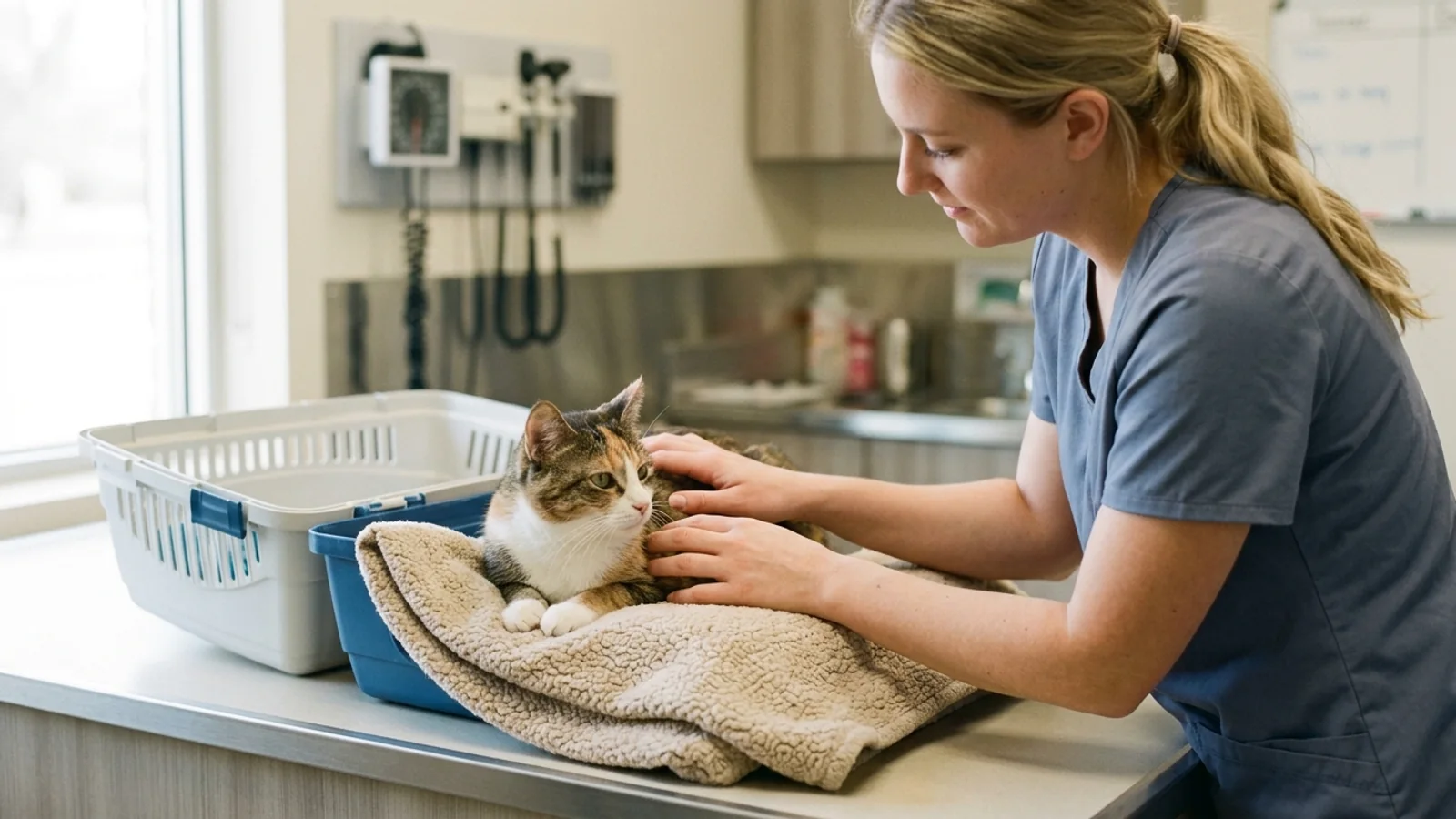
Carrier access: A carrier with a removable top can let staff begin the assessment while the cat stays in its familiar base. Bring bedding the cat knows and tell the team whether it prefers to stay partly covered. The collection position depends on the cat and the vein the team can safely use.
Towels and contact: A towel can provide a hiding place or gentle support. Staff should adjust their approach to the cat's response. A tighter wrap is not automatically a better solution, and owners should not attempt blood collection or restraining techniques themselves.
A quieter visit: Ask about a quiet waiting arrangement, moving directly into an examination room and reducing exposure to other animals. Slow movements, a comfortable surface and breaks can help create a more manageable interaction.
Prepare ahead: Leave the carrier accessible with familiar bedding and encourage voluntary entry over time. At booking, describe what happened during the last visit, including whether a medicine helped and whether it caused unwanted effects. This gives the team more useful information than simply calling the cat difficult.
These measures are options to discuss, not a guarantee that every cat can be sampled awake. If the team recommends sedation despite careful handling, ask what has changed the decision: current distress, illness, previous attempts or the need to complete a time-sensitive test. An agreed stopping point helps avoid turning an elective blood draw into a prolonged struggle.
Pre-Visit Medication: What the Evidence Supports
A pre-visit pharmaceutical is prescribed to reduce anxiety before travel or examination. The oral medicine may also cause sleepiness, but reduced fear and sedation are not interchangeable outcomes. Trials use different populations and scoring methods, so they do not establish one medication as best for every cat. In the United States, gabapentin and trazodone are used off-label for this purpose; Bonqat has a specific feline anxiety indication. 2025 review of feline pre-visit pharmaceuticals.
Gabapentin has controlled evidence for calmer visits. In van Haaften and colleagues' randomized, blinded crossover trial, 20 healthy pet cats with a history of stress or fractious behavior received gabapentin or placebo before two visits. Owner-rated stress and veterinarian-rated handling compliance improved with gabapentin. The procedures were examinations and blood-pressure measurements, not a trial of successful diagnostic blood draws. Sedation was common; unsteadiness, drooling and vomiting were also reported. All observed effects resolved within eight hours after administration in that study. That observation is not a recovery deadline for every patient. van Haaften et al., 2017.
Pankratz and colleagues studied a different setting: 53 community cats confined in cage traps. Gabapentin reduced fear scores compared with placebo, without a measurable difference in sedation scores over the first three hours. This supports a distinction between reduced fear and obvious sleepiness. It does not guarantee the same response in a pet cat undergoing venipuncture, or establish safety for cats with significant underlying illness. Pankratz et al., 2018.
Trazodone also has a small controlled feline study. Stevens and colleagues enrolled 10 healthy client-owned cats in a double-blind, placebo-controlled crossover trial. Transport anxiety and ease-of-handling scores improved with trazodone; sleepiness was the most common related adverse event. The evidence concerns travel and examination, not guaranteed blood-collection success. A veterinarian may consider it among the available options, but this trial does not show that it is the preferred substitute whenever gabapentin fails. Stevens et al., 2016.
Bonqat is a pregabalin oral solution approved by the FDA on November 17, 2023 for acute anxiety and fear associated with transportation and veterinary visits in cats. The approval concerns anxiety, not a separate indication for blood draws. The FDA describes administration approximately 1.5 hours before transportation or the visit, with use possible on two consecutive days. It is prescription-only and a DEA Schedule V controlled substance. Reported adverse reactions included mild sedation, unsteadiness and lethargy. Follow the veterinarian's written directions for your cat rather than choosing a dose from a study. FDA Bonqat approval announcement.
| Option | U.S. status for visit anxiety | What the studies assessed | Limit to discuss |
|---|---|---|---|
| Gabapentin | Off-label | Improved visit stress and handling scores in a 20-cat crossover trial | Sedation and other adverse effects occurred; healthy-cat results do not settle every patient’s suitability |
| Trazodone | Off-label | Improved transport anxiety and handling scores in a 10-cat crossover trial | Small trial; not a guarantee of successful venipuncture |
| Bonqat (pregabalin oral solution) | FDA-approved for feline transport and veterinary-visit anxiety; prescription, Schedule V | FDA-reviewed field study assessed travel and examination anxiety | Not approved specifically for blood draws; individual response and adverse effects still matter |
The practical next step is a written plan: which medicine, which formulation, when to give it and what to do if the cat refuses it or becomes more sedated than expected. The Cat Friendly Homes guidance notes that individual sensitivity matters and that cats with chronic kidney disease may need adjustments. Tell the clinic if your cat already takes gabapentin regularly; the pre-visit plan must account for that existing treatment. Cat Friendly Homes on pre-visit medication.
In-Clinic Sedation and Safety Planning
If handling and preparation are insufficient, or the test cannot safely wait, the veterinarian may choose injectable sedation. The drug combination and depth are selected for the cat's health and the procedure. Sedation is not automatically safer than general anesthesia in every compromised patient. AAHA discusses both options and emphasizes individualized planning rather than one fixed protocol for all diagnostic procedures. 2020 AAHA Anesthesia and Monitoring Guidelines.
The 2018 AAFP feline guidelines report higher anesthesia-related mortality in cats than dogs and address ways to reduce that risk. This does not give a numerical risk for your cat's short blood draw. The relevant discussion is the pre-procedure assessment, respiratory and cardiovascular monitoring, temperature support and observation during recovery. A normal routine blood panel does not replace assessment of the cat or guarantee that sedation will be complication-free. AAFP Feline Anesthesia Guidelines.
Drug choice can change cardiovascular measurements. Reader and colleagues compared alfaxalone-butorphanol with dexmedetomidine-butorphanol in healthy blood-donor cats; 11 enrolled and eight completed the study. Dexmedetomidine-butorphanol with blood donation had more pronounced effects on echocardiographic variables. The study assessed heart measurements after sedation and donation, which differs from collecting a small diagnostic sample. These results illustrate a planning consideration rather than establishing an owner treatment recommendation or the success rate of routine blood draws. Reader et al., 2021.
Some drugs have reversal agents, but reversal is not an instant guarantee of full alertness or a substitute for monitoring. Ask whether any component can be reversed, when that would be useful and what recovery is expected with the actual combination. The team needs to observe the cat's response and determine when discharge is appropriate.
What Stress and Sample Quality Do to Blood Results
A blood result is interpreted alongside the cat's condition and the circumstances of collection. Fear can cause genuine short-lived physiological changes; a damaged sample can cause measurement interference. These are different problems. Recording a stressful draw or a medication does not mean that every abnormal value should be dismissed.
Glucose: Cats can develop marked stress hyperglycemia. Cornell's eClinPath explains that an epinephrine-mediated increase can last several hours, and some cats temporarily pass glucose in urine when blood glucose exceeds their renal threshold. A single high glucose result, even with glucose in urine, therefore does not automatically establish diabetes. Persistent abnormalities still need investigation; fear is not a reason to ignore them. Cornell eClinPath on glucose.
White cells: An epinephrine or fight-or-flight response can produce mild mature neutrophilia with lymphocytosis, without a left shift. Cornell describes this pattern as particularly common in cats and usually diminishing within about 30 minutes after the animal calms. It differs from the corticosteroid pattern called a stress leukogram. The timing is a typical pattern, not a promise that waiting exactly half an hour will normalize every cat's CBC. Cornell eClinPath on leukogram patterns.
Sample interference: Hemolysis means red cells have broken down; it is often a collection or handling artifact, although it can also occur within the patient. Lipemia can follow a meal and interfere with some measurements. The effects depend on the test method, species and degree of interference. A flag does not automatically invalidate the whole panel. Ask which specific results are affected and whether another sample is needed. Your clinic should set any fasting instructions around the planned tests and your cat's medical needs. Cornell eClinPath on interferences.
How Sedation Affects Interpretation
Dexmedetomidine provides a specific example. Bouillon and colleagues used a randomized crossover study in eight healthy cats receiving intravenous dexmedetomidine or saline. Median glucose rose from 6.05 mmol/L at baseline to 11.55 and 12.0 mmol/L at 60 and 120 minutes. Insulin did not change significantly, and glucagon decreased; the study does not demonstrate that increased glucagon caused the glucose rise. The authors judged the transient glucose effects unlikely to significantly affect clinical practice, while advising clinicians to recognize them when interpreting results. The study does not establish how every injectable combination affects an older or ill cat. Bouillon et al., 2020.
For a glucose result that needs clarification, the veterinarian may consider clinical signs, repeat measurements or fructosamine to distinguish transient from longer-standing hyperglycemia. Fructosamine is supporting evidence, not a stand-alone verdict. Do not treat a normal result as definitive proof that diabetes is absent. Likewise, the glucose study does not establish that kidney markers, liver enzymes or thyroid results are unchanged under all routine sedation protocols.
| Situation | What may change | Useful discussion with the clinic |
|---|---|---|
| An anxious conscious draw | Glucose and the epinephrine-related white-cell pattern can change transiently | How did the cat behave, and does the result fit the clinical signs? |
| A draw after dexmedetomidine | Transient glucose increases occurred in a small healthy-cat IV study | What was given, when was it given, and does glucose need follow-up? |
| Hemolysis or lipemia reported by the laboratory | Specific measurements may be affected; method and severity matter | Which results remain usable, and would a repeat sample change the decision? |
| A test is repeated | The circumstances may differ between visits | Can the team compare medication timing, collection conditions and the relevant clinical findings? |
Keep the collection and interpretation plans connected. Asking when the sample will be taken is useful, but sampling immediately after an injection does not guarantee that drug effects have been avoided. Timing depends on the tests needed and the drugs selected. The team should record the medicines and collection timing and decide whether a particular result warrants follow-up.
When Bloodwork Is Needed Before Sedation
Bloodwork can help identify problems that change an anesthetic or sedation plan. An anxious cat may be unable to provide that sample while fully awake, creating a sequencing problem. AAHA acknowledges that fear can make an examination before sedation impossible. For elective procedures, it suggests considering rescheduling with an anxiety-management plan. Urgent cases require a different balance.
For a stable elective patient, ask whether a later appointment with prescribed pre-visit medication and a quieter handling plan is reasonable. The benefit of postponement depends on what the veterinarian is trying to find out and how soon the information is needed.
If a sample is needed today, ask what can be assessed safely beforehand and what uncertainty remains. History, the examination that is possible, existing records and the urgency of care help the veterinarian choose a plan; an impossible awake draw should not trigger repeated forceful attempts.
Tell the team about a murmur, diagnosed cardiomyopathy, kidney disease or previous delayed recovery. These details can change drug selection, monitoring and support. A brief examination or a normal blood panel cannot exclude all hidden disease, and no single protocol is suitable for all such patients.
The goal is to obtain necessary diagnostic information while managing both the cat's distress and medical risk. Ask the veterinarian to explain why the proposed sequence is preferable in this case. That explanation is more meaningful than a blanket assurance that sedation is harmless or that testing must always come first.
Home Preparation and Questions Before Consent
Pheromone products are sometimes suggested as environmental aids. Frank and colleagues' systematic review examined studies published through December 2008 and found insufficient evidence for several feline uses, including calming during catheterization, and lack of support for reducing stress in hospitalized cats. This older review does not settle the effectiveness of every newer product. It does mean that the reviewed evidence cannot justify relying on a pheromone alone to make a difficult blood draw safe. Frank et al., 2010 systematic review.
Before the appointment, obtain the clinic's own food, water and medication instructions. Fasting for a laboratory sample and fasting for a planned procedure are not interchangeable instructions. Do not impose a standard fasting period on a diabetic, young or unwell cat. If sedation becomes a possibility unexpectedly, tell staff when the cat last ate. Fasting also does not eliminate every risk of vomiting or aspiration.
What makes sedation necessary today? Ask whether the answer is severe fear, unsuccessful safe handling, urgent testing or another procedure being performed at the same visit.
What alternatives fit my cat? Ask about a quiet appointment, carrier-based assessment, prescribed pre-visit medication or rescheduling when medically reasonable.
What will be monitored, and through recovery? Ask who will observe the cat and how the team will assess breathing, circulation, temperature and readiness for discharge.
How do existing health problems affect the plan? Confirm that the veterinarian has the current medication list, relevant records and information about previous reactions.
How will you interpret the sample? Ask the team to explain any relevant effects of distress, medication timing or laboratory interference on the question the test is meant to answer.
What should I expect at home? Request written recovery instructions, the expected course for the specific drugs and a daytime and after-hours contact number.
Sleepiness or unsteadiness can occur after calming medicines or sedation, but the expected duration depends on the patient and drugs. Follow the clinic's discharge instructions, keep the cat in a quiet safe space and prevent falls while it is unsteady. AAHA's discharge guidance says patients may remain sedated but should be easily awakened and able to perform normal functions. Contact the clinic promptly if recovery differs from what it described. Seek urgent veterinary help for difficult breathing, collapse or inability to awaken. Repeated vomiting or marked weakness also warrants a prompt call.
Sources
AAFP/ISFM. 2022 Cat Friendly Veterinary Interaction Guidelines: Approach and Handling Techniques.
Robertson SA et al. AAFP Feline Anesthesia Guidelines. Journal of Feline Medicine and Surgery, 2018.
Grubb T et al. 2020 AAHA Anesthesia and Monitoring Guidelines for Dogs and Cats.
Cat Friendly Homes. Less Stressful Veterinary Visits for Your Cat.
IDEXX Pet Health. Why Your Veterinarian Recommends Preventive Blood Testing for Cats.