How Blood Draw Timing Changes What a Foal IgG Result Means
Match each newborn foal IgG result to the blood draw, first known colostrum intake, and any plasma treatment so your veterinarian can interpret it in context.

If your foal’s first IgG report arrived after a plasma transfusion, ask when the blood was collected. A sample taken after nursing and before plasma can help your veterinarian assess antibody transfer from colostrum at that point. A sample taken after plasma measures antibody levels after treatment. The report’s release time tells you when the result became available. To interpret either report, pair the collection time with the foal’s age at the draw, the first known colostrum intake, and any supplemental colostrum or plasma already given. Cornell’s newborn foal guidance · Equine hospital transfusion study
Why the foal’s age and first nursing matter
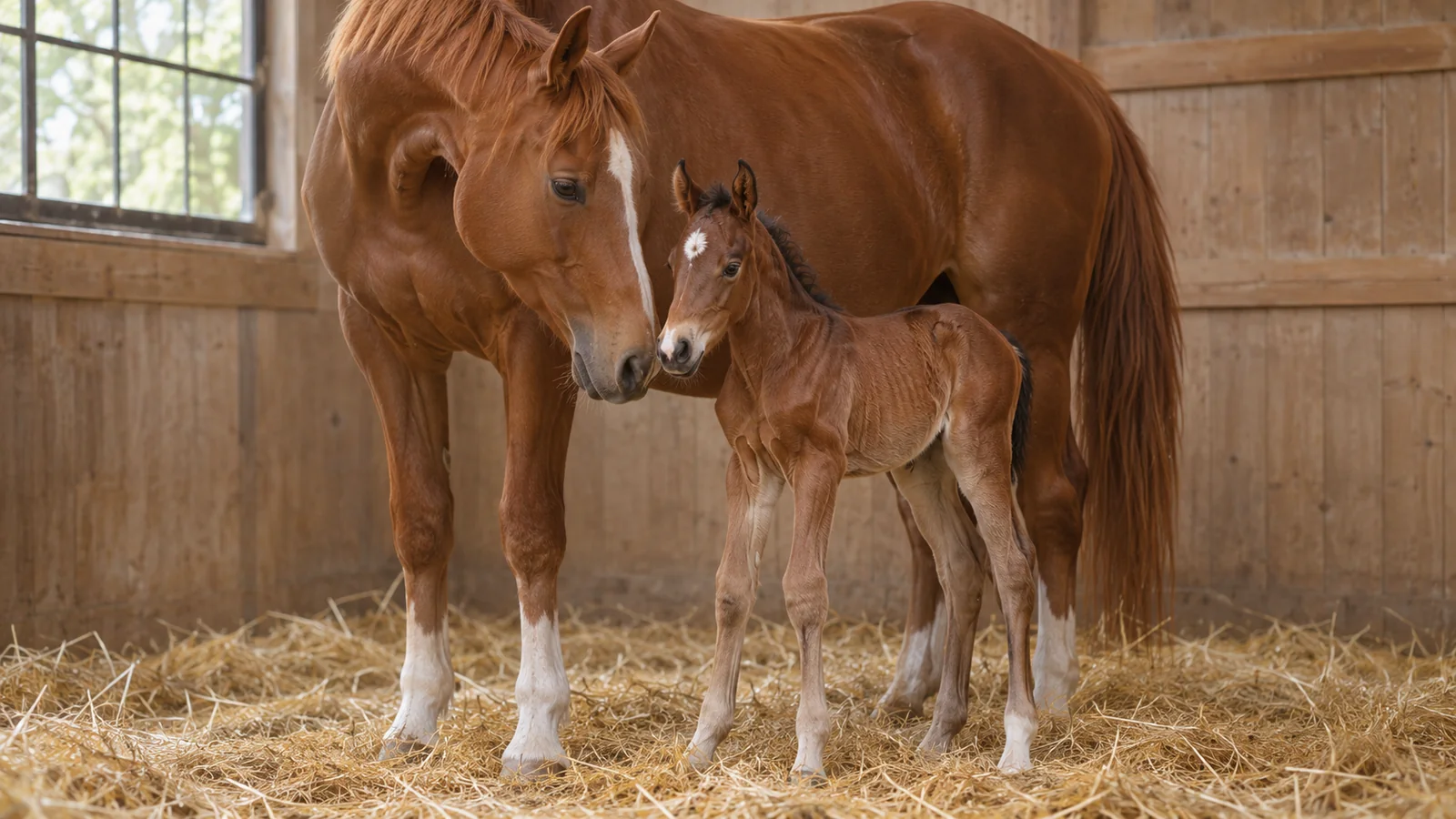
IgG, or immunoglobulin G, is a type of antibody. Newborn horse foals start with very little circulating IgG. After they take in colostrum, the mare’s first milk, they can absorb maternal antibodies through the gut during a limited period early in life. That process is called passive transfer. Measuring IgG in the foal’s blood helps the veterinarian assess the antibody transfer alongside the birth and nursing history and the physical exam. The clock begins at birth for some testing guidance and at colostrum intake for some laboratory interpretation. Cornell Equine Immunology Laboratory · Cornell’s newborn foal guidance
The timing difference matters when nursing was delayed or unobserved. Two foals drawn at the same age can have very different intervals between first intake and blood collection. Record the first time someone saw effective nursing or otherwise knows the foal received colostrum. If a foal was already up and beside the mare at the first check, record what was seen and leave the earlier intake time unknown. Tell the veterinary team whether any colostrum was given separately and when.
Published windows serve different purposes. Use the reference event in the middle column when you relay a time to the clinic. The attending veterinarian sets the timing for the individual foal.
| Source | What the interval is measured from | What the source describes |
|---|---|---|
| Teagasc foal guidance | Birth | Veterinary examination and IgG testing at 8–12 hours of age to assess passive transfer. |
| Cornell newborn foal care | Birth | Blood IgG assessment during the first 24 hours of life. The article describes intestinal antibody absorption during the first 18–24 hours of life. |
| Cornell Equine Immunology Laboratory | Colostrum ingestion | The laboratory’s serum IgG interpretation is anchored to 18–24 hours after ingestion. |
| Merck Veterinary Manual | Birth | General assessment at 18–48 hours of age, with possible earlier testing at 6–12 hours for high-risk neonates. |
An early screen can help the veterinarian assess risk when the foal’s condition or history calls for attention. A first-day assessment can address whether the foal has achieved passive transfer at the point being evaluated. An early sample taken after first nursing may already show substantial absorption. In one 2018 study of 20 foals at a single property, serum IgG was already near the group’s highest measured levels at 10 hours. The researchers found no statistically significant difference among the 10-, 24- and 48-hour draws in that cohort. These were foals with adequate transfer, studied with a specific laboratory method. The study illustrates how much can already have happened by an early draw in that setting. Neto and colleagues’ serial sampling study
Keep the clinical question alongside the timing. A low IgG result raises concern about insufficient antibody transfer. It takes the clinical exam and other findings to assess the foal for infection. Likewise, a result the veterinarian interprets as adequate still belongs alongside the foal’s condition and the history of standing and nursing. A foal that looks unwell needs the same prompt call even if the farm already has a reassuring report. Cornell’s newborn foal examination guidance · Teagasc’s guidance on passive transfer and illness
What changes after colostrum or plasma
Record supplemental colostrum separately from nursing at the mare. A sample obtained after supplemental colostrum can reflect antibodies absorbed from that intake as well as from nursing. If the veterinarian subsequently gives plasma, a blood draw obtained before the transfusion can serve as the baseline for the plasma intervention. That same sample may already reflect supplemental colostrum. In a record with more than one intervention, “before plasma” and “before supplemental colostrum” have different meanings. Cornell’s explanation of colostral transfer · Neto and colleagues’ sampling sequence
A sample taken after plasma can reflect antibodies given during treatment. The veterinarian may use the new result to assess the IgG level at follow-up, along with the examination and the timing of that draw. If the team confirms that the only sample was taken after plasma, leave the pretreatment concentration unknown. Even a precise laboratory value after transfusion cannot tell you what concentration was present beforehand or how much of the measured IgG came from nursing. If collection and treatment are recorded at the same rounded time, ask the clinic to confirm their sequence. Neto and colleagues’ before-and-after measurements · Armonaitė and colleagues’ transfusion study
The follow-up interval can affect what a comparison shows. In a 2026 retrospective review from one equine hospital, 110 foals received 150 hyperimmune plasma transfusions. The author abstract reports that, among the factors evaluated, baseline plasma IgG, foal weight, and the time to the post-transfusion measurement each had a correlation below 0.5 with the measured response. Foals tested within 12 hours after transfusion tended to have larger measured increases. Those associations describe the hospital series. The veterinary team chooses if and when to recheck an individual foal. Armonaitė and colleagues’ author abstract
A different result was possible in the 2018 single-property study. The researchers sampled at 24 hours of age before plasma and again at 48 hours of age after plasma. They found no significant change between those draws in their cohort of foals with adequate passive transfer. Together, the studies show why the reason for testing belongs next to the dates. The veterinary team needs to know whether an IgG check is assessing colostral transfer or monitoring a patient after treatment for inadequate transfer. Neto and colleagues’ serial sampling study · Armonaitė and colleagues’ hospital series
A report that arrived after treatment
Imagine a foal born at 2:10 a.m. with first observed effective nursing at 3:25 a.m. The veterinary team collects sample A at 12:30 p.m., when the foal is 10 hours 20 minutes old. The team later gives plasma and records that it finished at 2:20 p.m. The report for sample A arrives at 3:55 p.m., after treatment. The veterinarian orders a follow-up and collects sample B at 6:05 p.m., 3 hours 45 minutes after plasma finished. These are hypothetical times for matching records.
flowchart TD
    A["2:10 a.m. · Birth"] --> B["3:25 a.m. · First observed effective nursing"]
    B --> C["12:30 p.m. · Collect sample A before plasma"]
    C --> D["2:20 p.m. · Plasma transfusion finished"]
    D --> E["3:55 p.m. · Report for sample A arrives"]
E --> F["6:05 p.m. · Collect sample B after plasma"]Sample A still belongs to the pretreatment part of the record because the blood was taken before plasma. Sample B belongs to follow-up and carries both the foal’s age at collection (15 hours 55 minutes) and the elapsed time after treatment. Ask the clinic to match the reports by specimen ID if both arrived together or if one printout has only a release time. The matching matters even when the two results look similar.
Missing times can sometimes be narrowed down. If the clinic confirms a draw at noon and the mare was last seen without a foal at 1 a.m., with the foal first seen at 3 a.m., the estimated age at the draw is 9 to 11 hours. Share both observations and the age range. If first nursing was unobserved, the elapsed time since colostrum intake stays unknown. An estimated birth interval can help the veterinarian interpret the draw even when part of the nursing history is missing.
Read the specimen, assay, and result format together
An IgG report can give a concentration, an approximate value, or a range. Preserve whichever format the test reported. The specimen is the material tested, such as separated serum or whole blood. The assay is the method the clinic or laboratory used. An entry that says only “IgG done” leaves the next veterinarian without those details, even if the record has the correct collection time.
Cornell’s Animal Health Diagnostic Center lists separated serum for its EQUINE IGG test, a turbidimetric immunoassay, on the newborn foal wellness panel and lists same-day availability for the IgG result. The “0–48 hours” label describes the newborn panel. Ask the veterinarian when the sample was collected and what the laboratory reported for the individual foal. Cornell’s equine diagnostic plans and panels
The IDEXX SNAP Foal IgG test uses a visual comparison against spots calibrated at 400 and 800 mg/dL. The manufacturer’s product page shows five outcomes, from below 400 to above 800 mg/dL, with separate categories near each calibrator and between the two. The page describes the test as effective with serum or whole blood and notes that it is available only through veterinarians. Record the specimen the clinic actually used and copy the full category, including words such as “approximately” or “greater than” if they appear. IDEXX’s SNAP Foal IgG product page
For example, a stall-side result reported as “approximately 400 mg/dL” should stay approximate when it is placed beside a later numerical laboratory result. Both reports may use mg/dL, but the first is a visual category with limited precision. Subtracting 400 as if it were an exact concentration would assign precision the first test did not provide. Ask whether the veterinarian considers the results comparable and what each adds to the clinical picture. IDEXX’s visual result categories · Cornell’s laboratory test listing
A Brix percentage is another kind of result. In a 2026 study, Akköse and colleagues compared digital Brix readings with IgG measured by radial immunodiffusion in samples from 124 foals collected at about 12 hours of age. At the cutoffs selected for the main analysis, sensitivity was below 80% for both failure-of-transfer categories tested. Some cases classified by the direct method were missed at those cutoffs. Keep a Brix percentage labeled as an indirect estimate from the stated specimen. A reading from the mare’s colostrum concerns a different sample from a blood IgG measurement in the foal. Akköse and colleagues’ diagnostic-accuracy study · Teagasc’s distinction between colostrum and foal testing
Check whether two entries represent two blood draws or two tests on the same draw. A stall-side reading and a laboratory concentration may each have a different release time. If the clinic confirms both came from the same collection, group them by that collection time and keep their methods and wording separate. If the collection times differ, write each on its own line. This helps the next person see whether any difference was observed across time or across methods.
What to share with the equine veterinarian
Put the farm observations and the clinic’s sample information on the same dated timeline. Track dates as well as clock times if foaling or treatment crossed midnight. For an unwitnessed birth, share the interval when it may have happened and say which times are estimates. On the phone, start with the foal’s condition and what you know about standing and nursing. The clinic can help fill in the sample and treatment details.
Birth and first nursing. Record the date and known or estimated time of birth, first effective nursing if observed, and any difficulty standing or nursing. Use “unknown” where no one witnessed the event.
Other colostrum and veterinary care. Record any known supplemental colostrum and its time separately. For plasma, ask the veterinary team to confirm when the transfusion took place, including the finish time if they use that to anchor a follow-up.
Blood collection. For each draw, record the specimen ID if available, collection date and time, foal age, relation to interventions, and the purpose the veterinarian identified, such as early screening, a pre-plasma baseline, or follow-up.
IgG report. Keep the specimen type, assay, exact concentration or category, units, and release time. Attach the original result so the next person can check the wording and distinguish two draws from two copies of the same report.
A question to take to the clinic is “At the time this sample was taken, what had the foal received, and what were we trying to learn?” If it is still unclear which side of an intervention a draw belongs to, keep its timing marked uncertain until the clinic confirms it. If there is a recheck, ask what that sample will help the veterinarian assess and which previous result, if any, can be compared with it.
Sources
Newborn exam, early IgG check, and signs that warrant veterinary assessment. Cornell University College of Veterinary Medicine, Foal speed ahead
Maternal antibodies and interpretation anchored to colostrum ingestion. Cornell Equine Immunology Laboratory, Humoral Immunodeficiencies
Birth-anchored testing guidance and the limits of IgG as a health indicator. Teagasc, Failure of Passive Transfer
Clinical reference for general assessment and earlier high-risk testing windows. Merck Veterinary Manual, Failure of Transfer of Passive Immunity in Large Animals
Serial serum IgG measurements in 20 newborn foals. Neto et al., Pesquisa Veterinária Brasileira (2018)
Author abstract of a retrospective equine hospital transfusion study. Armonaitė et al., Veterinary Immunology and Immunopathology (2026)
Specimen and test listing for the newborn wellness plan. Cornell Animal Health Diagnostic Center, Equine Diagnostic Plans and Panels
Manufacturer’s foal-side specimen types and visual result categories. IDEXX, SNAP Foal IgG Test
Diagnostic-accuracy comparison of digital Brix readings and directly measured IgG. Akköse et al., Acta Veterinaria Hungarica (2026)