What to Tell Your Vet Before an Avian Polyomavirus Test
Bring your bird’s age, species, exposure dates and past results to the vet. Learn what avian polyomavirus PCR and antibody tests can tell you.

Before your bird has an avian polyomavirus (APV) test, give your veterinarian a dated history. Include the bird’s species and age, when it arrived, recent bird shows, boarding or travel, and which birds have shared a room or enclosure. Bring prior laboratory reports and APV vaccination dates. Tell the clinic whether you’re asking about a sick bird, a possible exposure, or an introduction to other birds. That question helps your vet choose a test and confirm the specimen and interpretation with the receiving laboratory.
PCR looks for viral DNA in the specimen collected that day. An antibody titer measures the bird’s immune response, which can reflect exposure or vaccination. A negative PCR result covers the submitted sample at that point in time. Your vet uses the history and examination to decide what it means for your bird and any birds it has been around (UGA test interpretation).
If a young bird becomes very weak, stops eating or develops unexplained bruising, call an avian veterinarian promptly. Tell the clinic if other birds are ill or if there has been a sudden death in the group. APV is one possible cause, and young birds can deteriorate quickly while a test is pending (Merck Veterinary Manual, Merck owner guide).
Write down the exposure history
Start with one line per bird. Use the same name or identifier on your notes and any old reports. For each event, give the date or a range you can stand behind. A note such as “boarded during the first week of October” gives the vet a time frame even if you can’t find the receipt. Write “unknown” for any gaps, including an uncertain hatch date or an unverified vaccination.
| What to record | Date or period | Details to bring |
|---|---|---|
| Bird identity | Hatch date or estimated age | Name or identifier, species and whether the bird was weaned at the time of concern. |
| Arrival or transfer | Purchase, adoption or move date | Where the bird came from and what the previous keeper can document. |
| Shows, boarding and travel | Dates away and return date | Where the bird went, how it traveled and whether it was near birds from other households. |
| New birds or shared space | First and last known contact | Which birds shared a room, enclosure, nursery or carrier. Note any change in housing. |
| Illness in the group | First signs or date of death | Which bird was affected, its age, what you observed and whether it was examined. |
| Prior APV or PBFD tests | Collection date on each report | The original report with the bird’s identifier, lab, test name, specimen and result. |
| APV vaccination | Recorded date of each dose | The vaccine record if available. Identify any dates reported verbally. |
Use the collection date when you line up an old report with an exposure. The date you received the result may be several days later. If a seller says a bird was tested before purchase, ask for the report and check that the identifier matches. Bring a copy of any results from birds that lived with yours, with the birds clearly identified.
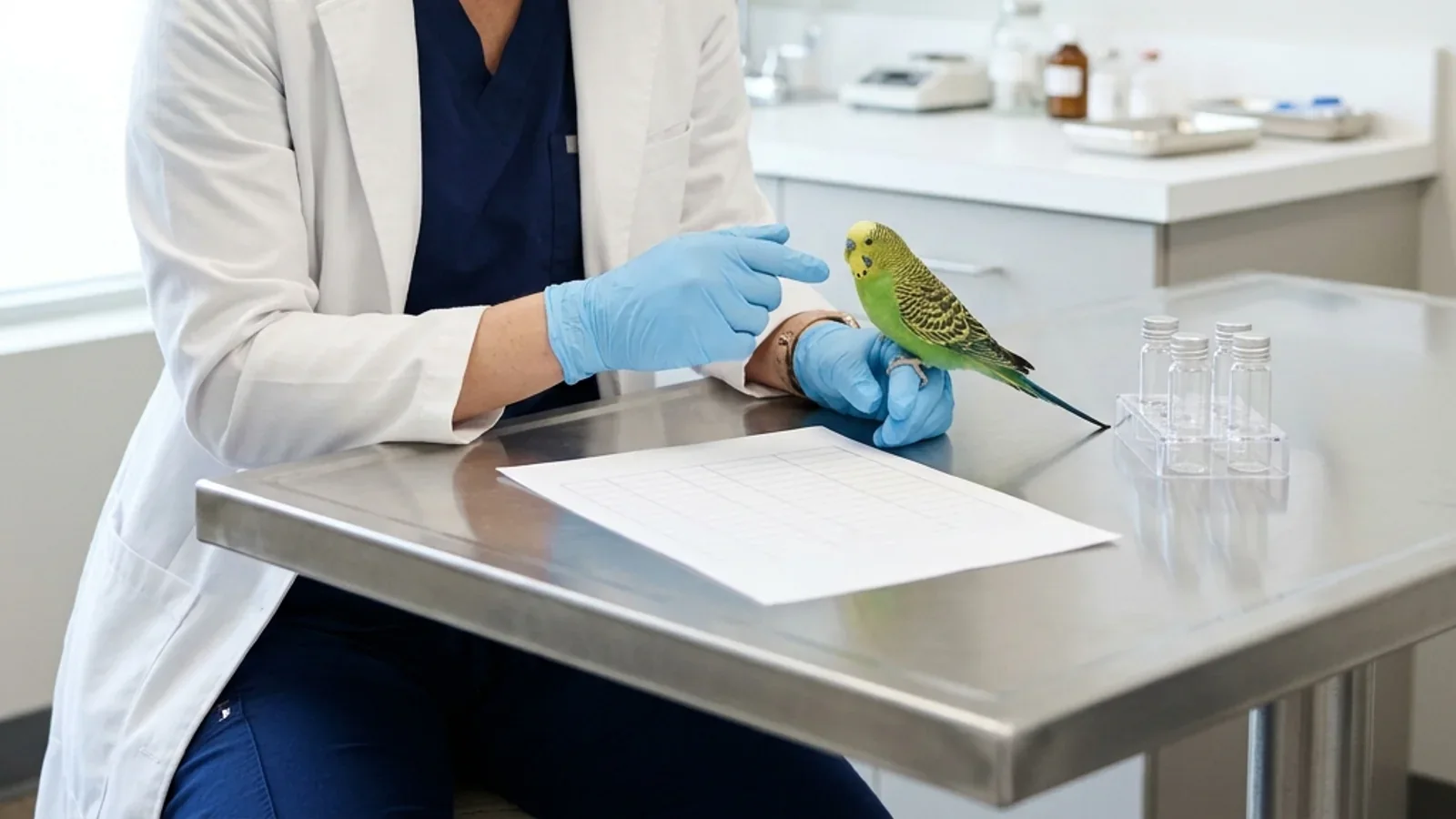
For example, suppose a young budgerigar joined a home with an adult cockatiel. The budgerigar’s negative PCR report lists a sample collected before pickup. The birds later spent time in the same room. Put both dates on the timeline. The old PCR result describes the earlier sample, and the period of shared housing is a separate event for the vet to consider. Note when that contact started, how long it lasted and whether either bird has developed signs.
Why the bird’s age and species matter
Veterinarians distinguish budgerigar fledgling disease from polyomavirus disease in other parrots. In young affected birds, signs can develop about 7 to 10 days after exposure. Preweaned chicks can decline rapidly, and Merck describes infection as often fatal in non-budgerigar parrots under roughly four months old. Some surviving budgerigars older than three weeks develop abnormal feathers, sometimes called French molt. These are patterns a vet can use to assess the history alongside the examination (Merck Veterinary Manual).
Adult birds can appear healthy while shedding virus. Merck describes adults as often developing antibodies and clearing the infection after a period of shedding that can last up to about 90 days. UGA describes shedding in non-budgerigar parrots as lasting weeks and sometimes months. These descriptions explain why it helps to record the ages of the birds that shared space, even if only one bird became ill (Merck Veterinary Manual, UGA test interpretation).
A 2020 study in eastern Turkey detected APV DNA in droppings from apparently healthy budgerigars and cockatiels in pet shops. The study found DNA from both APV and the virus that causes psittacine beak and feather disease in 14 of 113 samples (12.4%), all from budgerigars. That finding shows the two viruses can be detected together in birds that appear well. The percentage describes samples from that survey, and the PCR findings document viral DNA in droppings (Journal of Veterinary Research study).
What the receiving laboratory can test
At the University of Georgia Infectious Diseases Lab (UGA), live-bird testing can look for viral DNA or measure virus-neutralizing antibodies. The lab also offers in situ hybridization for affected tissue from parrots. Your veterinary team selects and collects the samples and checks the current submission form with the receiving lab (UGA test menu, UGA test interpretation).
| Test at UGA | Specimen listed by UGA | What the result describes |
|---|---|---|
| APV PCR | Choanal or cloacal swab, or 0.1 mL of whole blood | Whether the target region of APV DNA was detected in that specimen. |
| APV virus-neutralizing antibody titer | 0.1 mL of sterile, separated serum without hemolysis | The level of virus-neutralizing antibody in the serum sample. |
| APV in situ hybridization (ISH) | Formalin-fixed affected tissue, such as liver or spleen, from psittacines only | Whether APV was detected in the tissue examined, usually as part of a postmortem investigation. |
Ask the clinic to write down the receiving lab, exact test name and specimen it plans to submit. If the order is for a panel, ask which assays are included and how each will be reported. A panel can return both a DNA result and a titer, and your vet will interpret each with its own reference information. If a bird has died, the veterinarian can discuss whether necropsy and tissue testing would help explain the death or assess the rest of the flock (UGA test menu, Merck Veterinary Manual).
How to read the APV result
PCR detected or undetected
A positive PCR result means the lab detected the APV target in the submitted specimen. UGA treats detection as evidence of recent contact with a contaminated environment and advises investigating the source. Your timeline can help identify which locations and birds the vet should ask about first. The result alone leaves the source unresolved and needs to be read alongside signs and examination findings when illness is the concern (UGA test interpretation, Merck Veterinary Manual).
A negative PCR result means the lab did not detect its APV target in that specimen. Ask which sample was tested and what the result means given the date of the last possible contact. A negative from one bird leaves the status of its cage mates and the shared space open. If the history or examination still raises concern, the vet can discuss with the lab whether to repeat testing or use a different specimen (UGA test interpretation, 2013 laboratory comparison).
A single titer and a change between titers
UGA considers a titer below 20 negative, 20 or above positive, and 80 or above high. Antibodies can follow infection or successful vaccination, so bring the vaccine dates when you discuss a single result. A rise between paired serum samples can indicate recent infection, and UGA considers a rising or high titer a reason to investigate recent exposure. Those bands apply to UGA’s assay. Use the interpretation supplied by the lab that ran your bird’s test (UGA test interpretation).
Keep each titer with its own specimen date and laboratory report. To assess a change in antibodies, the veterinarian needs comparable antibody measurements from separate samples. Ask the clinic whether two titers can be compared and what change would affect the plan.
A negative PCR and a positive titer can both be accurate. One describes what was detectable in the submitted PCR sample and the other records an antibody response. If your report shows that combination, ask whether the dates and vaccination record help explain it and whether the vet still needs to investigate a recent exposure (UGA test interpretation).
What a recheck can answer
For parrots other than budgerigars, UGA describes repeat testing more than 90 days later as a way to see whether viral nucleic acid is still detectable. Ask the veterinarian which date anchors the interval for your bird and what the recheck would change. Merck separately describes a 90-day quarantine with testing for new birds entering an aviary. That recommendation addresses introduction of birds. UGA’s recheck guidance addresses the interpretation of repeat samples (UGA test interpretation, Merck Veterinary Manual).
Why the laboratory and specimen belong on the report
In 2013, Fitzgerald and colleagues sent five U.S. commercial laboratories ten known positives and ten known negatives each, with diluted and undiluted material. Two laboratories reported every prepared sample correctly, and one reached 90% accuracy. The other two reported 80% and 75% accuracy, with sensitivities of 60% and 50%, respectively. False negatives were the most frequent errors, particularly in dilute positive samples (Journal of Avian Medicine and Surgery study).
The study used a small set of prepared liver-homogenate swabs. Its percentages describe that set of samples and the participating labs in 2013. They cannot give you the chance that a particular bird’s result today is correct. If an earlier result came from a different lab, ask the vet to compare the original reports, including the specimen and the wording of the result, before interpreting the difference as a change in the bird (2013 laboratory comparison).
Check whether a prior report was for APV or PBFD
Psittacine beak and feather disease (PBFD) is caused by a circovirus. UGA lists separate PCR assays for that virus, including a feather panel that uses both whole blood and a preserved blood feather with skin attached. A report that just says “avian PCR” or “feather panel” may leave the target unclear. Look for the full assay name or ask the clinic to retrieve it. If feather changes prompted the visit, ask which virus the vet is investigating and what else could explain the changes (UGA test menu, Merck Veterinary Manual).
Agree on what the result will change
If you’re planning an introduction, tell the vet which birds would share space and when. Ask whether the clinic wants to assess other birds, change the housing plan or collect another sample before they meet. If the bird is ill, ask what else the examination points to and what the clinic needs to know while the results are pending. In a nursery or breeding aviary, report which chicks and adults were housed together and any illness or deaths. That gives the vet a basis for deciding whether the workup should include other birds or a necropsy.
The Merck Veterinary Manual describes supportive care for sick birds and veterinarian-led control measures such as isolation, hygiene and vaccination where appropriate. Its owner guide says APV vaccination is usually unnecessary for a single pet bird with no contact with other birds. Discuss vaccination in light of your bird’s likely future contacts and documented vaccine history. Tell the vet if you expect the bird to board, travel or live in an aviary (Merck Veterinary Manual, Merck owner guide).
Before you leave the appointment, write down who will call with the result, what to do about contact with other birds while waiting and which changes warrant an earlier call. If the vet recommends a recheck, ask for the planned date, test and reason in writing. Save that plan alongside the original report so everyone who cares for the bird has the same information.
Sources
University of Georgia Infectious Diseases Lab — Available Tests
University of Georgia Infectious Diseases Lab — Test Results and Interpretation
Merck Veterinary Manual — Polyomavirus Infection in Pet Birds
Fitzgerald, Olsen and Speer — Laboratory Reporting Accuracy of APV PCR (2013)
Adiguzel, Timurkan and Cengiz — APV and PBFD Virus in Companion Birds in Eastern Turkey (2020)