What Does a Negative PCR Swab Mean During Snake Quarantine?
Find out what a negative snake PCR swab tells you, which pathogens common quarantine panels cover, and what to ask your veterinarian before introducing a snake.

Read the pathogen result first
A negative ferlavirus (paramyxovirus) swab means the lab did not detect that viral target in the sample it tested. For a newly arrived snake, first check whether the report shows a standalone ferlavirus test or one result from a panel. To find out whether serpentovirus, reptarenavirus or Cryptosporidium was tested, look for each target by name.
Even an all-negative panel covers only the listed targets, the submitted specimens and the date they were collected. A negative result from an appropriate test can lower concern about a particular infection. It cannot, by itself, establish that the snake is free of infection or ready to join a collection. A reptile veterinarian can weigh that report alongside the exam and exposure history before you introduce the snake to a collection. If the transfer requires a veterinary health certificate, ask the receiving institution and your veterinarian which documentation applies.
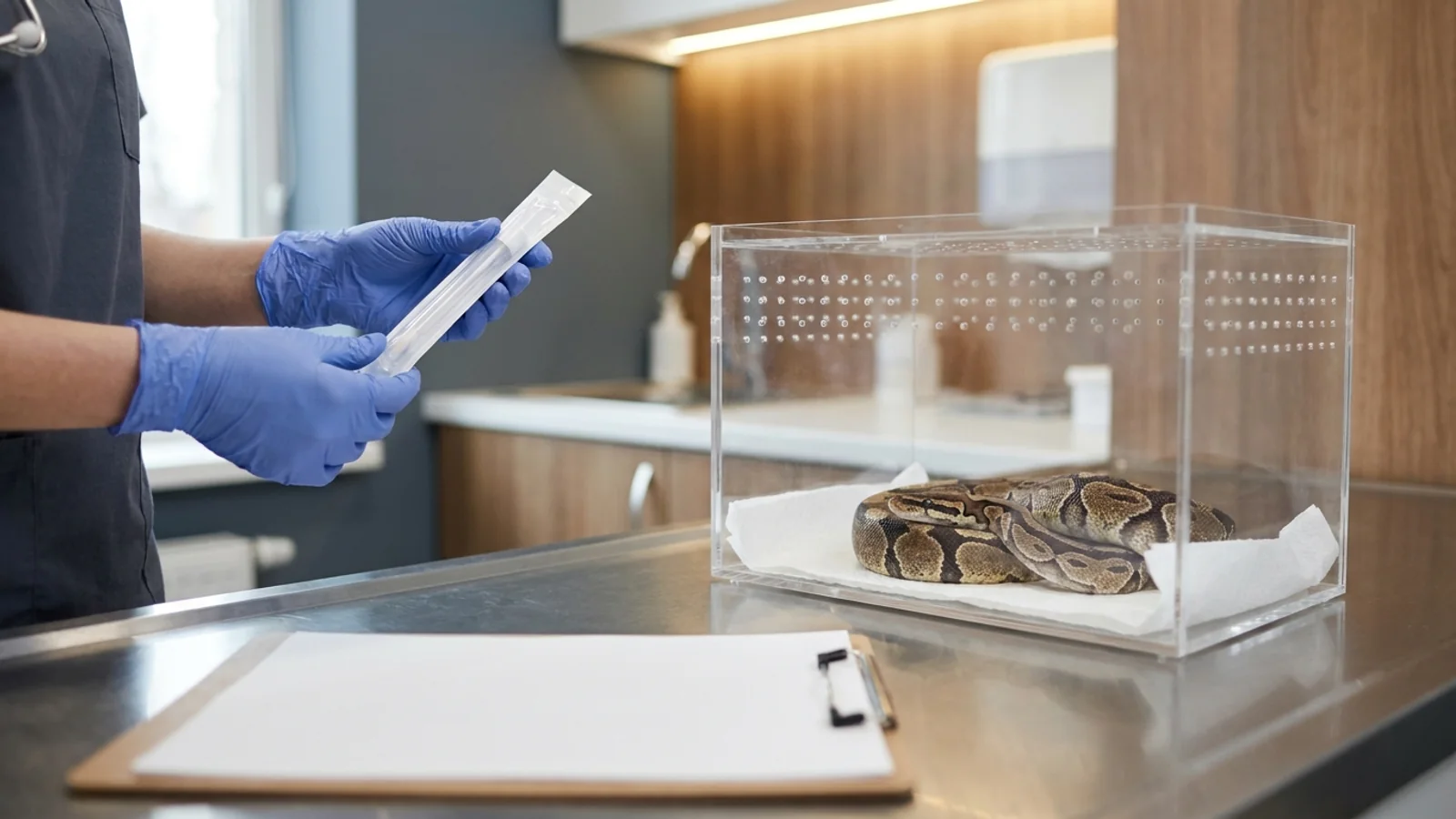
At the University of Florida Zoological Medicine Diagnostic (ZMDx) Laboratory, both snake quarantine panels require one oral specimen and one cloacal specimen. The respiratory panel accepts two oral or choanal swabs as one submission option. The neurologic panel accepts an oral swab and says that its diagnostic accuracy is unknown for all four targets. UF ZMDx ophidian test menu
Which pathogens are on the panel?
Ask for the original lab report if the seller gave you a summary such as “quarantine tested.” The lab name and panel code let you match the result to the menu. For an older report, the lab can confirm which targets the panel included when the test was run.
These four UF ZMDx panels are listed at $375 each as of November 14, 2026. FFPE means formalin-fixed, paraffin-embedded tissue. Confirm the current menu and specimen options with the lab before submission. UF ZMDx ophidian test menu and fees
| UF ZMDx panel | Targets | Specimens the lab lists |
|---|---|---|
| Boa/Python Quarantine (BPQP) | Generic Cryptosporidium, ferlavirus, reptarenavirus, ophidian serpentovirus | One cloacal specimen (cloacal/fecal swab, feces or tissue) and one specimen from the oral category (oral/choanal swab, lung or tracheal wash, or tissue). |
| Colubrid/Viperid/Elapid Quarantine (CVEQP) | Generic Cryptosporidium, ferlavirus, ophidian picorna-like virus, ophidian serpentovirus | One cloacal specimen (cloacal/fecal swab, feces or tissue) and one specimen from the oral category (oral/choanal swab, lung or tracheal wash, or tissue). |
| Ophidian Respiratory Disease (ORP) | Mycoplasma, ferlavirus, reptarenavirus, ophidian serpentovirus | Two oral or choanal swabs, a lung or tracheal wash, fresh tissue, or FFPE tissue. |
| Ophidian Neurologic Disease (ONP) | Ferlavirus, ophidian picorna-like virus, reptarenavirus, Sunshine virus | Fresh brain tissue, FFPE brain tissue without acid decalcification, or an oral swab. Swab accuracy is unknown for all targets. |
A respiratory screen leaves a parasite question open. If a boa arrives with an all-negative ORP report, the results cover the four respiratory panel targets. Record Cryptosporidium as untested on that panel and ask the veterinarian whether the animal’s history warrants separate testing.
Check for the virus relevant to the exposure. BPQP includes reptarenavirus. CVEQP includes ophidian picorna-like virus in its place. If a snake was housed with a reptarenavirus-positive boa, a negative CVEQP result leaves that exposure unanswered.
Check the parasite test name. UF lists generic Cryptosporidium as a DNA test and C. serpentis separately as a species-specific quantitative PCR (qPCR) test. The performance of the species-specific assay in the study below cannot be assigned to the generic panel test.
Why the specimen matters
A swab represents the site sampled. For example, C. serpentis infects the stomach, and the parasite’s oocysts can be shed intermittently. That makes a cloacal swab an indirect way to look for a gastric infection. A veterinarian can use the animal’s clinical signs and exposure history to decide whether a different specimen would answer the question more directly. Bogan et al., 2022
A lab can accept a specimen even when the chance of detecting infection with it is unknown. UF lists an oral swab for its neurologic panel alongside brain tissue options. If a snake has neurologic signs and the oral swab is negative, ask the veterinarian how that result affects the workup given the menu’s explicit uncertainty about swab accuracy. UF ZMDx neurologic panel
What the eastern indigo snake study found
Bogan and colleagues reviewed records from one captive eastern indigo snake colony and compared results from a C. serpentis-specific probe-hybridization qPCR with microscopic examination of stomach tissue. The swabs had been collected before the tissue exams. Sensitivity estimates how often qPCR detected infection in snakes classified as infected by the study’s reference method. Bogan et al., 2022
| Specimen | Samples | Estimated sensitivity | 95% confidence interval |
|---|---|---|---|
| Gastric biopsy taken at necropsy | 11 | 100% | 63.06%–100% |
| Gastric swab collected three days after a meal | 8 | 87.50% | 42.13%–99.64% |
| Cloacal swab | 34 | About two-thirds | 44.68%–84.37% |
The study’s repeat-testing model estimated sensitivity of 99.8% for three gastric swabs and 96.3% for three cloacal swabs. Those figures assume each test has the same chance of detecting infection and that each miss is independent. For example, repeatedly sampling while an animal is shedding little parasite material could produce several negatives for the same reason. The authors calculated the projections from the single-test estimates. The study did not measure those three-test rates prospectively. Bogan et al., 2022
The small sample groups and wide intervals matter when applying these results. A 100% estimate from 11 necropsy biopsies gives limited precision, and the observed performance belongs to the study’s species and assay. The paper also cites a 12-to-28-week prepatent period in Pantherophis snakes, meaning the period before the parasite begins shedding detectable stages. That range comes from a different group of snakes. It illustrates why exposure timing matters when a veterinarian plans testing and cannot supply a general quarantine length. Bogan et al., 2022
How the assay and timing affect a negative result
Ferlavirus assays can differ
Ferlavirus is an RNA virus associated mainly with respiratory disease in snakes and sometimes with neurologic signs. Reverse transcription PCR (RT-PCR) copies viral RNA into DNA so the assay can amplify the target. The primers that select a stretch of that genetic material help determine which viral variants the assay can detect. Kolesnik et al., 2019
Kolesnik and colleagues compared three ferlavirus RT-PCR protocols using cultured isolates and tissues from experimentally infected corn snakes. For the tissue comparison, they counted 44 samples positive by at least one method and used those samples as the denominator. Protocol I detected 84.1%, protocol II detected 29.5%, and protocol III detected 93.2%. Kolesnik et al., 2019
In a separate part of the same experiment, protocols I and III detected all four cultured isolates, and protocol II detected two. Those results show how much detection can vary across methods, even for the same named virus. If a report simply says “paramyxovirus PCR” and the snake has compatible signs or a known exposure, the veterinarian can ask the lab what the assay covers and whether it is suitable for the specimen submitted. Kolesnik et al., 2019
Serpentovirus results can change over time
Hoon-Hanks and colleagues sampled 639 captive snakes in 12 U.S. collections and followed pythons in one collection for 28 months. The study used oral or choanal swabs in living snakes. Some previously positive snakes had occasional negative results followed by a positive result. The researchers did not see a snake go from consistently positive to consistently negative. They considered several explanations for the intermittent negatives, including shedding below the test’s detection limit and technical factors. Hoon-Hanks et al., 2019
In the outbreak response described for that collection, staff kept some snakes with negative PCR results apart from the main collection because of respiratory signs or exposure concerns. The study describes separate housing, dedicated tools and clothing, and disinfection as part of the response. If an exposure took place after sampling, the previous report describes the snake before that event. Give the veterinarian both dates when discussing whether to repeat testing. Hoon-Hanks et al., 2019
Keep an inconclusive result separate from a negative one when reviewing a series of tests. In the serpentovirus study, the researchers used a different PCR approach for some inconclusive samples because it could better detect more divergent viruses. Ask the reporting lab what an inconclusive result means for its assay and whether it needs another specimen. Hoon-Hanks et al., 2019
Reptarenavirus targets and repeat results
Thiele and colleagues studied 183 boa constrictors in one breeding colony using a blood RT-PCR designed around an RNA segment found in that colony. The authors describe how genetic diversity complicates assay design. In the few boas the authors could retest, the results pointed to several possibilities. Some boas may have cleared the virus or had viral RNA in their blood only intermittently. The study measured RNA in blood with a colony-specific test, so it gives no estimate of how well a quarantine swab would detect these infections. Thiele et al., 2023
Why species and housing history matter
Ask about breeding, shared housing and illness in the source collection even if the snake appeared well at handoff. The captive-collection studies found infected animals without outward signs, and the boa study found an association between cohousing and reptarenavirus infection. Hoon-Hanks et al., 2019 Thiele et al., 2023
The following counts come from the 12 U.S. collections in the Hoon-Hanks study. The percentages describe the study sample, which included many more pythons than other snakes. The counts show that the researchers found infections beyond pythons. The small groups with zero detections provide limited evidence about how often infections occur in those groups. Hoon-Hanks et al., 2019
| Snake group | Tested | Positive | Share positive | Respiratory findings |
|---|---|---|---|---|
| Pythons | 414 | 156 | 37.7% | Signs were common among infected pythons assessed for respiratory disease. |
| Boas | 79 | 8 | 10.1% | Only one of the eight positive boas had a nonzero respiratory score. |
| Colubrids | 116 | 1 | 0.9% | The one positive colubrid had no apparent signs. |
| Elapids, vipers and lamprophiids | 30 | 0 | 0% | No infections were detected in these small groups. |
The test menu uses “nidovirus” alongside “ophidian serpentovirus.” Ferlavirus is a separate entry labeled “paramyxovirus.” When the seller’s report uses one of these alternate names, match it to the lab’s target list before assuming which virus was tested. UF ZMDx ophidian test menu
In the Thiele study, 9 of 155 clinically normal boas whose blood smears lacked inclusion bodies still tested positive for the reptarenavirus RNA target in blood. A report stating “no inclusion bodies seen” describes what was visible under a microscope. Ask whether molecular testing was also performed before interpreting that result as an infection screen. Thiele et al., 2023
New symptoms change the question you are asking of the laboratory. A screening result from before the snake stopped eating or developed respiratory signs belongs in the history for the veterinary exam. For a ball python whose main change is appetite, see our guide to telling seasonal fasting from signs of illness. Ball python fasting and illness
How to follow up on a positive result
A positive result indicates that the assay detected its genetic target. When a snake is ill, the veterinarian has to determine whether that finding explains the symptoms. When a snake looks healthy, the same finding can matter for how it is housed and what further evaluation it needs. PCR alone does not establish whether the organism is viable.
Check what was detected. For a generic Cryptosporidium result, ask whether the pathogen was identified to species and whether a species-specific test would change the decision. UF ZMDx test menu
Ask how the veterinarian would establish clinical disease. For suspected boid inclusion body disease, the Merck Veterinary Manual describes using PCR with biopsy of internal tissue to look for characteristic inclusion bodies. The clinician chooses the workup based on the individual snake. Merck Veterinary Manual
Clarify discordant findings with the lab. If earlier tests gave different results, ask whether repeating the test or using a second method would clarify the finding. In the serpentovirus study, researchers used additional PCR methods to confirm positives. Hoon-Hanks et al., 2019
If a positive screen comes back while a snake is in quarantine, keep the snake apart from resident animals while you discuss the finding with the veterinarian and receiving collection. Bring the full report and any earlier results so the vet can consider assay choice, specimen and timing together.
What to record with the report
Keep the full report with the intake record. If the seller has results from several dates, keep them in order and connect each one to the individual snake and specimen. Give the veterinarian enough history to tell whether the newest result covers the exposure you are concerned about.
Use the intake record to capture these details:
Laboratory, panel and targets. Save the lab name, test code and each result. Record targets of concern that were outside the panel as untested.
Specimens and assay. Record the sites and number of specimens. If the summary lists one specimen for a panel that requires two, ask for the submission record. Ask the lab to clarify the assay or target if the report is vague.
Dates and contact history. Record sampling and arrival dates, recent cohousing or breeding, and contact with animals that became ill. When gastric sampling is part of the workup, include the feeding history the veterinarian requests.
Clinical findings and earlier tests. Bring exam findings, changes in appetite or weight, and any earlier reports that might show how results changed over time. Keep any official movement paperwork with the transfer records.
Questions to ask before introducing a snake
Review the report with your reptile veterinarian and whoever manages the receiving collection. Decide what information they need before the snake is moved into shared housing.
Which targets on this report address the snake’s species and exposure history? Which concerns are still untested?
Were the requested specimens submitted, and was the snake sampled before or after its most recent potential exposure?
Would a repeat test or a different specimen change the decision? What clinical findings would prompt a sooner assessment?
How will the snake be kept apart during follow-up, and what test results, veterinary findings or transfer documents does the receiving collection require?
Sources
University of Florida College of Veterinary Medicine, Zoological Medicine Diagnostic Laboratory. Panel targets, specimen requirements and fees. Accessed November 14, 2026. Ophidian Tests and Panels
Kolesnik E, Hyndman TH, Müller E, Pees M, Marschang RE. BMC Veterinary Research, 2019. Accessed November 14, 2026. Comparison of three different PCR protocols for the detection of ferlaviruses
Hoon-Hanks LL, Ossiboff RJ, Bartolini P, et al. Frontiers in Veterinary Science, 2019. Accessed November 14, 2026. Longitudinal and cross-sectional study of serpentovirus in captive snakes
Bogan JE Jr, Wellehan JFX Jr, Garner MM, Childress AL, Jackson B. Parasitology Research, 2022. Accessed November 14, 2026. Evaluation of a Cryptosporidium serpentis qPCR assay in eastern indigo snakes
Thiele T, Baggio F, Prähauser B, et al. Microbiology Spectrum, 2023. Accessed November 14, 2026. Reptarenavirus RNA and inclusion bodies in a boa breeding colony
Divers SJ and Comolli JR. Merck Veterinary Manual, professional reference. Accessed November 14, 2026. Viral Diseases of Reptiles