What to Confirm Before Submitting an Avian Chlamydia PCR Sample
Confirm the bird species, assay target, specimen sites and shipping instructions with the receiving lab. Learn what an avian Chlamydia PCR result can tell you.

Confirm the assay before collecting a sample
Before collecting a sample for avian Chlamydia PCR, give the receiving veterinary laboratory the bird’s exact species and ask which assay and specimen it accepts for that bird. Confirm whether the test screens for several chlamydial species or identifies Chlamydia psittaci, and whether the lab wants specimens from one visit or across several days. Get the lab’s instructions for pooling, the container, transport and hazard labeling before collection. Cornell avian test menu · Missouri submission instructions · Texas A&M submission instructions
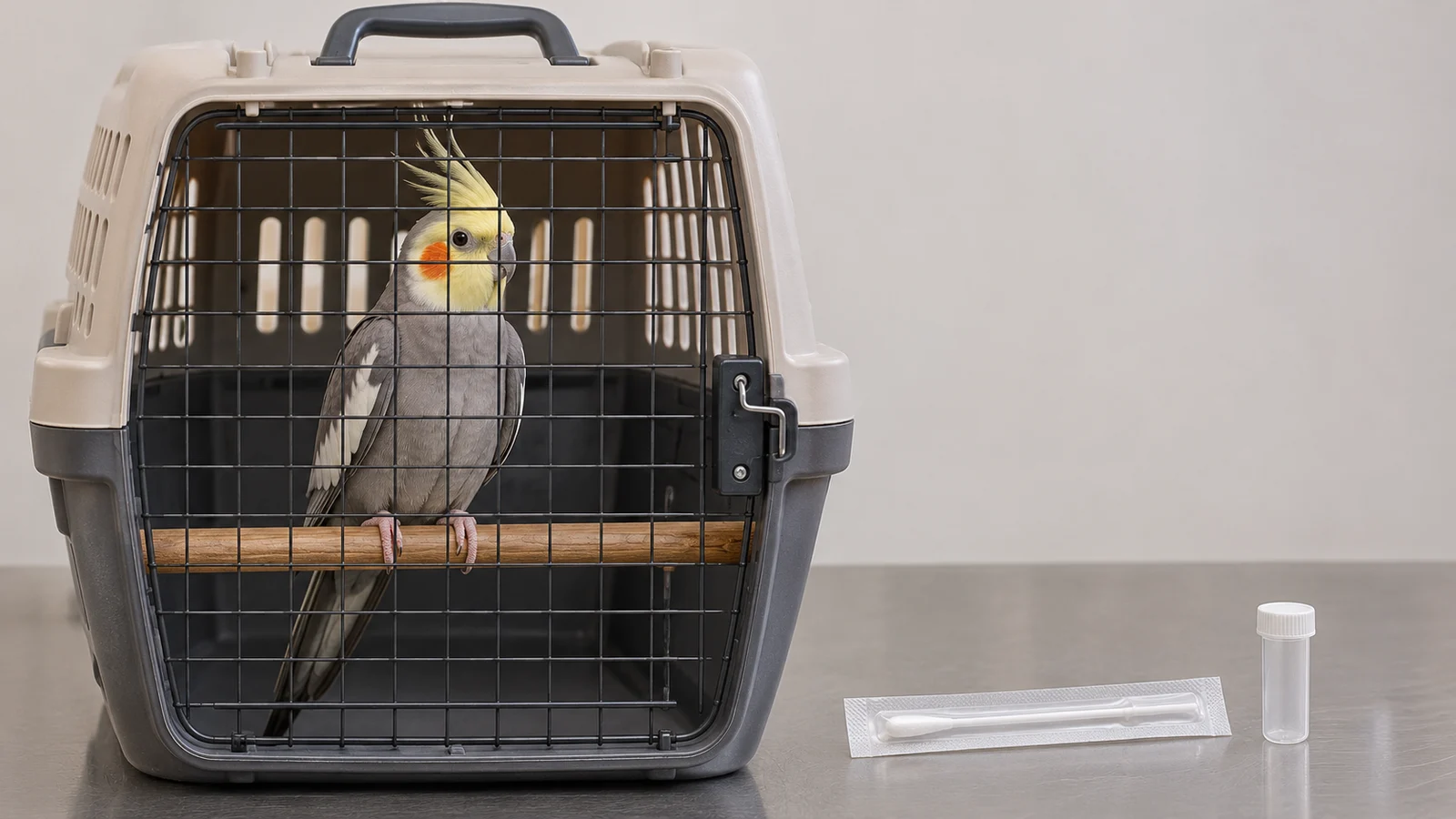
In a cockatiel with conjunctivitis or nasal discharge, avian chlamydiosis is one possibility. Record whether the order is part of a workup for illness, an investigation of a known exposure, or screening of a bird without signs. This gives the clinician and laboratory the context for choosing a specimen and interpreting the report. A single negative swab can miss an infection when the bird sheds intermittently. A positive report establishes detection of the assay target in that specimen. Clinical findings, exposure history and the scope of the test determine what the detection means for that bird. Merck Veterinary Manual · Cornell PCR interpretation
Check what the assay can identify
Start with the decision the result has to support. If the veterinarian needs to identify C. psittaci, ask whether the report will name that species or report a broader Chlamydia target. A broad assay may target the Chlamydiaceae family or the Chlamydia genus and report detection without identifying which species was present. Merck notes that PCR primers and methods vary across laboratories, so check the target for the actual order. Ask whether species-level follow-up is available, whether it can use the original sample, and whether the clinic should collect a separate specimen at the same visit. These are questions to settle with the receiving lab when species identification matters. Cornell assay list · Merck diagnostic overview
Cornell’s avian menu lists Chlamydia PCR under CHPCR. Its molecular diagnostics page lists that code separately from the C. psittaci PCR code CPSI and from the assays named for C. abortus, C. felis and C. pecorum. The avian index establishes that CHPCR appears on the menu. Ask Cornell which code fits the bird, specimen and clinical question, since the index itself gives no swab or transport instructions. Cornell avian test menu · Cornell molecular diagnostics
The University of Missouri test title contains “psittaci,” and its description names C. psittaci, C. felis and C. abortus among the organisms the assay detects. Ask Missouri what a positive report will identify before treating it as species confirmation. Texas A&M describes its assay as detection of Chlamydia spp. by real-time PCR. Its public entry gives no species-level reporting procedure. These examples show why the assay description and report format matter as much as the name on the requisition. Missouri assay description · Texas A&M assay description
Match the bird and specimen to the lab menu
A catalog that lists “avian” gives the clinic a starting point. Provide the common species name and, if needed to resolve ambiguity, the scientific name. Then ask whether the lab accepts the proposed specimen from that species and what it can say about the assay’s suitability for that combination. The five US laboratory entries below show where the catalog answers that question and where the clinic needs to confirm details directly. They describe published menus and instructions. They offer no comparison of diagnostic accuracy.
| Laboratory and test | What the public menu establishes | What to confirm for this bird |
|---|---|---|
| Cornell AHDC · CHPCR | The avian test index lists CHPCR. Cornell’s PCR interpretation page separately lists CPSI for C. psittaci. | Confirm the target, accepted specimen and transport for the chosen code. |
| University of Missouri VMDL · Chlamydia PCR | Lists birds among the species served. The menu includes conjunctival, nasal, pharyngeal, choanal, cloacal and tracheal swabs, plus feces. | Confirm the sites and pooling for this bird. Check how the lab reports species and where its hazard notices go. |
| Texas A&M TVMDL · Chlamydia spp. rtPCR (1272) | Lists birds among the species served. Its menu includes choanal or cloacal swabs, fresh tissue and avian feces. | Confirm the specimen and amount for this case. Check the overnight cold-pack instructions and any additional paperwork. |
| University of Georgia IDL · Chlamydia sp. PCR | The PCR menu lists conjunctival, choanal or cloacal swabs and whole blood. The separate panel entry also lists separated, non-hemolyzed serum. | Confirm which specimens the chosen order needs, along with the blood tube, swab medium and shipping conditions. |
| North Dakota State VDL · Chlamydia species PCR | The menu lists sheep, goats, wildlife/exotics and other. Lung and abomasum are preferred specimens. | The menu gives no companion-bird swab entry. Ask whether the proposed species and specimen are accepted before collecting. |
The University of Georgia PCR and panel entries illustrate why specimen choice follows the exact order. Serum on the panel entry gives no basis for substituting serum for a specimen on the standalone PCR order. Likewise, North Dakota State’s different specimen menu leaves companion-bird swab acceptance open. Keep the lab’s answer with the requisition, especially when the clinic’s usual lab changes or a sample is being forwarded. Georgia test menu · North Dakota State test menu
Choose the sites and agree on pooling
For an individual bird, the Merck Veterinary Manual lists conjunctival, choanal and cloacal swabs as preferred samples for PCR or culture. Georgia’s interpretation guide discusses PCR of those sites together with antibody testing to help assess infection status. Use that clinical context when talking to the lab. For instance, the published Texas A&M entry names choanal and cloacal swabs, while the Missouri entry also names conjunctival swabs. If the workup calls for an ocular specimen, check acceptance before using a kit intended for a different site. Merck diagnostic overview · Georgia results guide · Texas A&M specimen menu · Missouri specimen menu
A 2013 study by Sheleby-Elías and colleagues tested paired oropharyngeal and cloacal specimens from 117 captive psittacines in Costa Rica using a nested PCR method. Two birds had C. psittaci DNA detected in the oropharyngeal specimen and two different birds had it detected in the cloacal specimen. None of the four had detection at both sites. Each site contributed detections that the other site missed in that study. Oropharyngeal swabs were the upper-airway specimens in the study, so the finding gives no separate estimate for choanal or conjunctival swabs. The study design also gives no estimate of clinical sensitivity for a current commercial assay. Sheleby-Elías et al., paired-site study
Ask whether the lab wants separate specimens, allows pooling sites from one bird, or requires a specific combination. Separate reports preserve which specimen produced a signal. A single report on a pooled sample generally gives the result for the pool. Record the sites represented in every tube. For a mixed aviary, make clear which specimen came from which bird and discuss any proposed group sampling with the lab before applying an individual-bird protocol. This matters if the next decision depends on assigning a result to a specific bird. Merck on testing individuals and flocks
Record collection dates and antimicrobial exposure
Sampling multiple sites addresses where the organism may be detected. Sampling on multiple dates addresses when a bird may shed it. Those are separate choices to make with the clinician and lab. Merck describes collecting multiple samples across three to five days to improve the chance of detecting intermittent shedding in subclinically affected birds. Use that interval as clinical context when asking whether serial collection fits this case. The receiving lab should specify how many samples it wants, whether to combine them, how to store each one and when to send them. Merck on intermittent shedding
Give each sample its collection date and site, and document whether it was collected before, during or after antimicrobial treatment. Include the known drug and timing, and say when the history is uncertain. In their introduction, the Costa Rican study authors cite prior literature noting that antibiotics may reduce the amount of the organism in a specimen below the test’s detection limit. That observation gives no fixed interval after a dose. A result from a sample collected after treatment started still needs that context. The treating veterinarian should decide what further sampling, if any, makes sense. Sheleby-Elías et al., introduction
When a negative report arrives and clinical suspicion remains, reconstruct the submission before deciding what to do next. Compare what the lab received with what the team intended to send. A report on one cloacal swab and a report covering several identified sites represent different sampling histories. Note whether the specimen met the lab’s acceptance criteria and whether the lab reported any quality problem. That review gives the veterinarian a specific reason to ask about another site, another date or another diagnostic method. Merck diagnostic overview · Cornell reporting and controls
Follow the receiving lab’s transport instructions
Set out the supplies using the instructions for the actual destination. Missouri directs clinics to keep swabs moist with viral transport medium or to use 1–2 mL of sterile saline in a red-top tube. It requests cold packs for shipping and specifies 2–3 tablespoons of feces in a leak-proof container. Missouri asks for “High Risk” on both the primary container and the form and “Special Handling” on the outside of the package. Missouri container and labeling instructions
Texas A&M prefers moist swabs and recommends 1–2 drops of sterile saline in a sterile, leak-proof container. It lists 1 g when avian feces are submitted, specifies overnight shipping on cold packs and excludes swabs sent in bacterial culture media such as gel or charcoal. A clinic switching between these labs should update the order, supplies and shipping plan together. The difference between drops and milliliters is a practical reason to attach the receiving lab’s instructions to the order. Texas A&M sampling and packing instructions · Missouri submission instructions
If PCR and bacterial culture are both planned, verify the specimen and container for each order. North Dakota State explicitly requests a separate swab in bacterial transport medium when bacterial culture is also ordered. Before dispatch, reconcile the tube labels with the requisition, check arrival timing with the lab, and confirm applicable shipping classification and markings through the clinic’s shipping procedure. Missouri’s handling notices are instructions from that lab. Packaging classification is a separate check for the actual shipment. North Dakota State transport guidance · Missouri handling notices
Handle zoonotic risk and reporting before dispatch
CDC identifies breathing in dust from dried bird droppings or respiratory secretions as the most common route by which people acquire psittacosis. Infected birds can shed while appearing well. Have the team follow its infection-control procedure for suspected avian chlamydiosis, including protective equipment for examination and steps to limit dust exposure. Discuss relevant exposure history with the owner. CDC advises people who become ill after handling pet birds or live poultry to contact a healthcare provider. CDC transmission and exposure guidance · Merck precautions for examination
Check applicable animal-health reporting and submission requirements before dispatch. The Texas A&M entry flags possible additional requirements or restrictions from the Texas Animal Health Commission or USDA APHIS. Use the animal-health authority and receiving lab for the relevant jurisdiction to confirm what triggers reporting, who handles it and whether paperwork must accompany the specimen. Texas A&M regulatory notice · Merck reporting overview
Send bird specimens through a veterinary laboratory that has confirmed acceptance. CDC says its C. psittaci PCR lacks validation for avian specimens and that it declines those specimens. The CDC submission page describes the separate public-health laboratory pathway for people and points to an avian laboratory list for bird testing. CDC specimen acceptance criteria
Read the report against the original order
For a detected result, first verify the target the laboratory reported. If the assay detected a group of chlamydial organisms, species identity remains open. The review by Ravichandran and colleagues documents other avian Chlamydia species, including C. avium and C. gallinacea. Detection of DNA alone leaves organism viability and the cause of the bird’s signs unresolved. A result from a clinically well bird also calls for exposure and sampling context. Merck flags cross-contamination during aviary sampling as one possible explanation to investigate when a result is unexpected. Ravichandran et al., avian chlamydiosis review · Merck PCR interpretation
If the report includes a cycle threshold (Ct), use the reporting lab’s interpretation. Cornell explains that a lower Ct generally corresponds to more target nucleic acid in the tested specimen. When the Ct meets or exceeds the assay’s limit of reproducibility, Cornell reports detection with a comment that the finding may not be reproducible. Read that comment with the result. Avoid using Ct as a measure of the bird’s illness or comparing values from different assays, sites or dates as if they measured the same thing. If a change in Ct would affect a decision, ask the lab whether the samples and methods support that comparison. Cornell Ct and reproducibility guidance
For a negative result, record which target was undetected in which specimen. If the report is inconclusive or flags a specimen problem, clarify the reason with the lab before interpreting it as a negative. When the clinical picture and PCR disagree, the veterinarian can consider other evidence, including repeat sampling or serology where appropriate. Georgia’s guide discusses combining PCR and antibody results to assess infection status. A single PCR is one part of that assessment. Cornell reporting and controls · Georgia results guide · Merck diagnostic overview
Clinic requisition checklist
Complete the relevant fields before collection and check the finished order against the specimen labels before dispatch. Keep the confirmed instructions where the person preparing the shipment and the clinician reading the report can both find them.
| Field | What to record |
|---|---|
| Bird and reason for testing | Patient ID, exact species, relevant signs or exposure, and whether the order is for workup, screening or follow-up. |
| Laboratory and assay | Receiving lab, order name and code, reported target, and whether species-level follow-up is needed or available. |
| Specimens | Each accepted site or specimen type, the requested material and amount, and which specimen is in each container. |
| Sampling plan | Each date, whether collection spans several days, and the lab’s instructions for separate or pooled specimens. |
| Antimicrobial history | Known drug and dates relative to collection, including the most recent administration if known. |
| Container and shipment | Medium and amount, container, storage and delivery plan, and the applicable packaging and hazard markings. |
| Reporting and confirmation | Any animal-health documentation, who is responsible for reporting, and the laboratory contact or catalog entry used to confirm the plan. |
Sources
The laboratory examples describe public US test menus and submission instructions checked on November 12, 2026. Confirm the current requirements with the receiving laboratory before collecting or shipping a specimen.
Cornell University Animal Health Diagnostic Center — Avian Tests
Cornell University Animal Health Diagnostic Center — Interpretation of PCR Results
Texas A&M Veterinary Medical Diagnostic Laboratory — Chlamydia spp. (rtPCR)
University of Georgia Infectious Diseases Laboratory — Available Tests
University of Georgia Infectious Diseases Laboratory — Test Results