
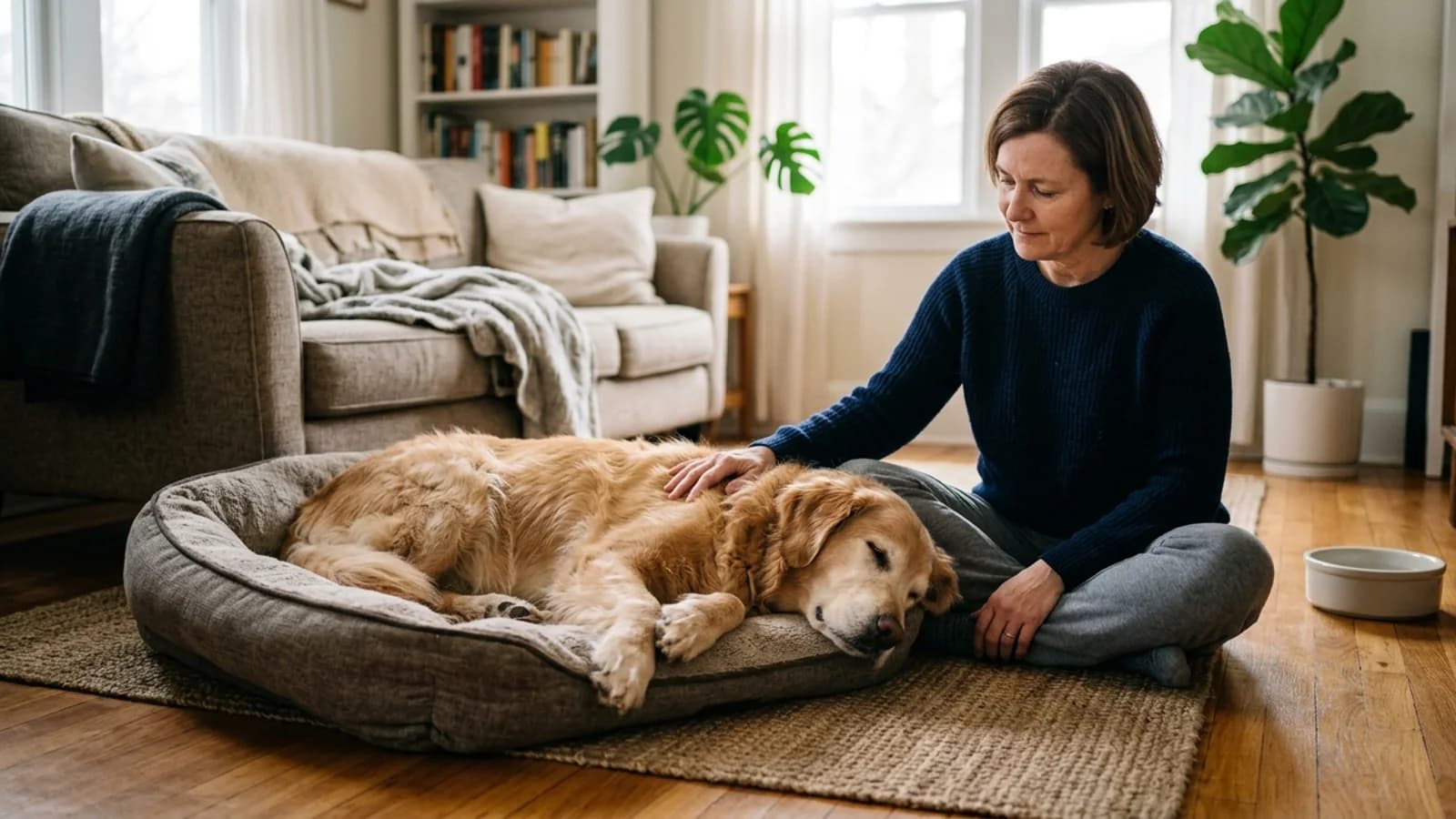
How to Plan Home or Clinic Euthanasia for Your Pet
Compare home and clinic pet euthanasia on comfort, cost, and emergency boundaries. Plan access, sedation, cremation, and grief support before you need them.

The short answer: match the setting to your pet, not to a rule
When a dog or cat is nearing the end of life, the decision is where the goodbye should happen and how to arrange it before a crisis. Home can be gentler for a stable pet who is distressed by the car or the clinic. A clinic is usually faster, often costs less, and is the safer place when a pet is struggling to breathe, has collapsed, has pale gums, or has pain that is not controlled. Families also need a practical plan for aftercare and for grief that can start before the death.
Neither setting is the more loving choice. Match the setting to your pet's stability, how your pet handles the clinic, and what your family can arrange. In both settings, the expected standard is sedation or anesthesia first. The AVMA's 2020 euthanasia guidelines recommend pre-euthanasia sedation or anesthesia whenever practicable, and the 2016 AAHA/IAAHPC end-of-life guidelines say the same preliminary step can be used at home. That is so the pet is relaxed before the final injection. It is not a promise that every practice uses the same drugs or the same timing.
Home suits a stable pet who is distressed by travel or the clinic, and it gives the family more privacy, fewer time constraints, and room for more people to be present. The AAHA/IAAHPC guidelines name those practical advantages. A clinic is usually faster to reach and often costs less. It is the right place when a pet is in respiratory distress, has collapsed, is unresponsive, has pale gums, or has uncontrolled pain. Do not wait for a home appointment in those situations.
No published trial compared home euthanasia with clinic euthanasia on owner grief. The setting advice comes from professional guidelines and clinical teaching. BluePearl's in-home hospice FAQ, which also describes that hospital group's own service, says most pets do not die peacefully in their sleep and frames euthanasia as shortening a death rather than shortening a life. Your veterinarian decides timing and whether your pet is stable enough to wait for a home visit.
To help families visualize the decision path based on clinical stability and household priorities, the following structured workflow illustrates how to navigate setting selection before an acute crisis arises:
flowchart TD
  Start[How stable is your pet right now?] --> CriticalCheck{Breathing crisis, collapse, pale gums, uncontrolled pain, or extreme distress?}
  CriticalCheck -- Yes --> EmergencyClinic[Go to the nearest open clinic now]
  CriticalCheck -- No --> StabilityCheck{Has your veterinarian said a home visit can wait?}
  StabilityCheck -- No or unsure --> ClinicianConsult[Call your veterinarian or an emergency clinic before you book]
  StabilityCheck -- Yes --> PreferenceCheck{What fits this pet and this family?}
  PreferenceCheck -- Clinic distress, and a home veterinarian can reach you --> HomePath[Ask about lead time, after-hours coverage, and travel limits]
  PreferenceCheck -- You need speed, a lower fee, or nobody covers your address --> ClinicPath[Book the clinic and ask about a quiet room]
  HomePath --> PrePlan[Put the aftercare type and price in writing]
ClinicPath --> Personalize[Bring familiar bedding and confirm who may attend]When the clinic is the safer, faster choice
A clinic is sometimes the safer choice, and sometimes the only practical one. Home is not a more compassionate default. Naming the situations that should not wait relieves owners of the idea that leaving the house is a failure.
A clinic's practical advantage is speed. A mobile veterinarian has to drive, and a same-day home visit is not guaranteed. Zoetis's client guide says in-hospital euthanasia can usually be done faster and is especially relevant for respiratory distress, cardiac arrest, or a pet who is unresponsive. Waiting at home prolongs suffering in those crises. That includes sudden feline aortic thromboembolism, described in our guide to feline saddle thrombus triage and outcomes. Go to the nearest open clinic. The team there decides what that pet needs on arrival, which may include oxygen, pain control, or euthanasia without a travel delay.
Home euthanasia costs more largely because the visit includes the veterinarian's travel time. Lap of Love's cost page, reviewed in September 2026, lists a Chicagoland base package of $530. That package includes the veterinarian's time and travel inside the service area, light sedation, the procedure in a chosen spot at home, a clay paw print, a lock of fur, and grief materials. It is one company's price in one metro area, and the page says base prices vary by location. Clinic euthanasia is often less expensive. One posted example is Animal Humane Society in Minnesota: $110 for dog and cat euthanasia, $170 with communal cremation, and $270 with private cremation, on its end-of-life page in September 2026. Those are one nonprofit's fees, and the page does not say an urn is included. Ask the clinic you would actually use.
Many clinics have a room set aside for goodbyes. The Animal Medical Center describes that option and, when a practice does not have one, suggests bringing a favorite blanket or bed, treats, and a portable speaker. Call ahead and ask whether you can go to a quiet room without waiting in a busy lobby, and ask what that room is actually like.
Families choosing a clinic goodbye can take concrete, practical steps to personalize the experience and recreate the comforts of home:
Bring familiar bedding: transport your pet on their favorite orthopedic bed, fleece blanket, or an unwashed sweater carrying your scent, and place it directly on the clinic floor or low examination table.
Curate comforting sounds and smells: bring a portable Bluetooth speaker to play familiar calming music, gentle acoustic songs, or nature sounds that your pet hears at home.
Offer 'bucket list' treats: if your pet still wants food, offer a usual favorite that your veterinarian says is appropriate. Do not give chocolate, xylitol, grapes, raisins, or other known toxins, even as a last meal. A delayed appointment, or a pet who is only sedated, can still be harmed by those foods.
Request a direct room entrance: call the front desk upon arrival from the parking lot so staff can escort you and your pet directly into the private room, bypassing other patients and waiting-room commotion entirely.
When home fits: stress, mobility, privacy, and presence
For a pet who is stable, home is a reasonable setting. The 2016 AAHA/IAAHPC guidelines say each AVMA-approved injectable euthanasia method can be accomplished as safely in the home as in the hospital. They also say home avoids travel, keeps the pet in familiar surroundings, increases privacy, allows more family members to be present, and tends to reduce time pressure. Those are practical advantages. They are not proof that home produces less grief.
The clearest reason to choose home is to skip a hard trip. The AAHA/IAAHPC guidelines say at-home euthanasia avoids travel and keeps the pet in familiar settings. A frail cat may panic in a carrier. A dog in severe orthopedic pain, including a dog with the bone cancer covered in our guide to osteosarcoma in dogs, may hurt when lifted into a car. If the pet is stable enough to wait, staying on a familiar bed can remove that trip. It does not remove every stress. A stranger at the door can still frighten some animals.
Home also offers more privacy and fewer time constraints than a clinic schedule. The AAHA/IAAHPC guidelines describe increased owner privacy, more family members present, and less pressure from the clock. People can gather without sharing a small exam room. How long the team can stay depends on that veterinarian's schedule.
Whether other pets should be nearby is a choice you make with your veterinarian. The AAHA/IAAHPC guidelines say a home visit can include more family members. Tufts' pet-loss page says surviving animals may eat or sleep differently, or may search for a missing companion, and that they often need time and extra attention. A protective dog or a cat who hides can make a home visit harder than a clinic visit. The Animal Medical Center lists both of those drawbacks.
To clearly weigh the practical tradeoffs between both environments, the following comparison matrix summarizes key clinical, environmental, and financial factors:
| Decision Factor | In-Home Euthanasia | Veterinary Clinic Euthanasia |
|---|---|---|
| Medical Suitability | Ideal for chronic, stable palliative conditions where decline is predictable and pain is controlled. | Essential for acute emergencies, respiratory crisis, trauma, collapse, or oxygen-dependent patients. |
| Patient Stress & Travel | No car ride if the veterinarian comes to the home. A fearful reaction to a stranger is still possible. | Requires vehicle transit and hospital entry, which may cause distress in clinic-averse pets. |
| Family Privacy & Time | More privacy and fewer time constraints, according to AAHA/IAAHPC. The visit can still have practical limits. | Varies by facility; dedicated comfort rooms provide privacy, but scheduling limits may apply. |
| Presence of Loved Ones | Easier to include more people. Other pets are a judgment call with your veterinarian, not a requirement. | Ask how many people the room can hold. A dedicated goodbye room is common in some hospitals and absent in others. |
| Scheduling & Lead Time | Lead time varies. Same-day visits exist at some practices and not at others. Ask before you need the answer. | An open emergency hospital can see a crisis without a home appointment. A general practice may be closed overnight, so identify that hospital in advance. |
| Baseline Financial Cost | Usually higher because of travel. One priced example is Lap of Love's $530 Chicagoland base package. Get a local quote. | Often lower. Animal Humane Society in Minnesota posts $110 for dog and cat euthanasia alone. Other clinics set their own fees. |
Despite its clear advantages, veterinary professionals emphasize that home euthanasia is not a universal ideal for every animal or household. Honest clinical counter-considerations include:
Territorially protective or aggressive dogs: dogs that bark frantically, guard entryways, or experience intense territorial aggression when strangers enter the home may become extremely agitated when a mobile veterinary team arrives with medical equipment, requiring heavy muzzle restraint or stressful oral sedatives.
Fearful, hiding cats: cats that flee under beds, behind large appliances, or into crawl spaces whenever doorbell rings can experience intense panic if family members must physically extract them for treatment, defeating the goal of a serene home passing.
Persistent home memory associations: some owners feel genuine psychological discomfort with having their pet die inside their personal living space, expressing concern that their final memory of the pet will forever overshadow the family living room or bedroom.
Planning access before you need it: questions to ask this week
The useful step this week is to learn who can reach your address before a nighttime crisis. Ask about lead time, after-hours coverage, and what to do if your pet declines suddenly. Timing is a different question, covered in our guide to quality-of-life scales for dogs and cats. Use that guide for when. Use this article for where, access, cost, and aftercare.
Begin by having an open, non-crisis conversation with your primary care veterinary practice. Ask the following concrete questions:
Do any doctors in your clinic perform house-call euthanasia for established patients? Some general practices offer home visits for established clients, sometimes only on certain days or within a short driving distance. Ask what your clinic actually does.
How much advance notice is required to schedule a home visit? Determine whether the practice can accommodate a same-day visit if your pet deteriorates rapidly during regular business hours.
Which mobile hospice services or emergency hospitals do you formally recommend when you are closed or fully booked? Having a vetted referral list ensures you contact trusted, reputable providers.
Next, research dedicated mobile veterinary hospice and euthanasia providers serving your postal code. Contact them directly to clarify the practical details of their service model:
Scheduling flexibility and response windows: Ask how far in advance appointments must be booked, and specifically ask: 'If my pet takes a sudden downturn overnight, do you maintain an emergency same-day standby list?'
Operating hours and after-hours availability: Verify whether they operate strictly during standard business hours (e.g., Monday through Friday, 9:00 AM to 5:00 PM) or provide on-call evening, weekend, and holiday appointments, and identify the surcharge associated with non-standard hours.
Geographic service radius and travel fees: Confirm whether your home falls within their primary service boundary or incurs supplemental per-mile travel fees.
Aftercare transportation protocols: Clarify whether the mobile doctor transports your pet's body directly in their vehicle following the appointment, or whether a separate pet crematory transport service is dispatched.
Lap of Love, one national hospice network, says it has more than 450 veterinarians across the United States and Canada and has supported more than one million pet families since 2009. That is the company's own description of its scale, not an independent census of home-euthanasia access. A large network still leaves gaps. Ask which veterinarians actually serve your address, including evenings and weekends. If nobody does, plan the clinic route before you need it.
What the appointment looks like in each setting
Knowing the order of the visit can lower fear. Practices do not follow one mandatory script. The elements below are what to ask about, drawn from the AVMA owner page, the 2020 AVMA guidelines, the AAHA/IAAHPC guidelines, Veterinary Partner, and the Merck Veterinary Manual.
Step 1: Administrative details and paperwork first. Many teams finish consent forms and payment at the beginning so they are not handing you a clipboard during the procedure. Ask whether that practice does this. It is a common courtesy, not a rule in the guidelines.
Step 2: Choosing a calm, comfortable position. At home, your pet can remain on their favorite orthopedic bed, curled on a couch, resting on a soft blanket in the garden, or cradled in your lap. In a clinic comfort room, the team arranges soft fleece blankets on the floor or a low padded platform so you can sit beside your companion.
Step 3: Sedation or anesthesia first. The AVMA's 2020 guidelines recommend sedation or anesthesia before euthanasia whenever practicable. The AAHA/IAAHPC guidelines say preliminary sedation or anesthesia can be given before an at-home euthanasia as well. The aim is a pet who is relaxed and unaware before the final injection. Routes, drug combinations, and how many minutes that takes vary by patient and by practice. Your veterinarian can tell you what they use. This article does not give a dose or a minute-by-minute protocol.
Step 4: The final euthanasia injection. After the pet is sedated, the veterinarian gives an injectable euthanasia drug. AVMA's owner page describes pet euthanasia as most often an injection of a drug that causes death, sometimes after a tranquilizer. Catheters and needle types vary. The veterinarian, not a fixed clock, decides when the pet is ready for that injection.
Step 5: Clinical verification of death. The veterinarian confirms death before the body is moved for aftercare. Merck states that death must be confirmed before remains are disposed of. Families can ask the veterinarian to say clearly when the heartbeat and breathing have stopped.
Understanding normal physiological changes at death. Veterinary Partner tells owners to expect a few physical changes that can be startling if nobody has mentioned them. They are not a sign that the procedure failed.
The eyes usually remain open: the pet will probably not close its eyes. Facial muscles relax. The veterinarian may gently close the lids, and they may open again.
Involuntary muscle twitching: a final twitch can occur. Veterinary Partner names this so owners are not alarmed. It is not a sign you should interpret on your own as awareness or pain. Ask the veterinarian to explain what they are seeing.
Agonal gasps or reflex sighs: a final gasp can also occur. Veterinary Partner lists a twitch or a gasp among the changes owners may see. Do not treat that reflex as evidence the pet is still conscious. The veterinarian's confirmation of death is the medical finding.
Sphincter relaxation: bladder or bowel release is possible as muscles relax. You can ask the team to place a pad under the bedding.
The intensely personal choice of owner presence. Professional end-of-life guidelines stress that deciding whether to remain present for the final injection is an entirely personal choice. There is no single 'right' or 'strong' way to grieve. Some owners find deep closure in holding their companion until the final heartbeat; other owners prefer to be present only for the initial sedation, saying their final loving goodbyes as their pet falls asleep, and stepping out of the room before the final injection. Both choices are completely loving and respected by veterinary professionals without judgment.
Memorial keepsakes: veterinary teams routinely assist with memorialization. You can request clay or ink paw prints, nose prints, clipped locks of fur, and the return of their collar and tags. Preparing these requests in advance ensures the team handles them with gentle care.
What it costs: sourced examples and fee drivers
End-of-life fees vary by region, pet size, travel, timing, and aftercare. The numbers below are named examples and publisher ranges as of September 2026, not a quote for your address. Cancer treatment costs are a different decision, covered in our guide to dog cancer treatment costs. None of these figures should be read as the price your local clinic or crematory will charge.
In-home euthanasia baseline pricing. For a priced example, Lap of Love's cost page lists a Chicagoland base package of $530. It includes the veterinarian's time and travel within the service area, light sedation, euthanasia in a chosen spot at home, a clay paw print, a lock of fur, and a grief-support booklet. The page says to look up local pricing because the base package varies by location. Treat $530 as one metro example from September 2026, then get a quote for your address.
Common in-home fee surcharges. Mobile services often apply specific supplemental surcharges that families should anticipate:
After-hours, weekend, and holiday bookings: Lap of Love lists an extra $100 to $200 for evening, weekend, holiday, or last-minute appointments. Ask every other provider for their own after-hours fee.
Extended travel radius: Lap of Love says appointments outside the service radius may incur a travel fee. The page does not publish a universal per-mile dollar amount. Ask what your address would add before you book.
Large or giant breed handling: Lap of Love says large, aggressive, or exotic pets may cost more because they can require extra handling or sedation. Ask for the handling charge that applies to your pet.
Clinic-based euthanasia pricing. Clinic fees are often lower than a home visit. The posted clinic example here is Animal Humane Society in Minnesota: $110 for dog and cat euthanasia, $170 with communal cremation, and $270 with private cremation, on its end-of-life page in September 2026. The page does not itemize an exam, a catheter, or an urn inside those totals. Call 952-435-7738, the number on that page, to confirm the current fee. A private clinic in another city sets its own price.
Pet insurance coverage realities. Lap of Love's cost page says some pet-insurance plans specify coverage for euthanasia and cremation, and that coverage is not universal. It also says insurance is unlikely to cover veterinarian travel fees or add-ons such as keepsakes and memorials. Read your own policy. Do not assume an accident-only plan, a wellness plan, or any particular illness plan pays for this visit. The insurer's certificate is the authority, not a general rule of thumb.
| Service Component | What the named source reports | Sourced Benchmark Example | What the Fee Covers |
|---|---|---|---|
| Clinic Euthanasia (Procedure Only) | AHS Minnesota posted fee: $110 | Animal Humane Society (Minnesota), posted September 2026: $110 euthanasia; $170 with communal cremation; $270 with private cremation | The page lists the package price for dogs and cats. It does not itemize an exam, catheter, or urn. Confirm inclusions by phone. |
| In-Home Euthanasia (Base Package) | $530 in one metro area | Lap of Love cost page, Chicagoland example, September 2026. The page says local base prices differ. | Veterinarian time and travel in the service area, light sedation, the procedure at home, clay paw print, lock of fur, and grief materials. |
| After-Hours / Weekend Surcharge | $100–$200 at one company | Lap of Love's posted surcharge for evening, weekend, holiday, or last-minute visits. | This company's posted surcharge. Ask other mobile services for their own after-hours fee. |
| Communal Cremation (No Ashes) | About $50–$200 (PetMD); medians about $100–$175 where published (Hallowed Paws) | PetMD usual range, plus Hallowed Paws' self-published 2026 medians of published prices. Not a government dataset. | Ashes are not returned. Lap of Love says its communal ashes are scattered. Scattering location is not standardized. |
| Private Cremation (Ashes Returned) | About $150–$450 (PetMD); published medians about $180–$390 by size (Hallowed Paws) | PetMD range, urn not necessarily included. Hallowed Paws medians are of published prices in its 1,225-provider compilation. | The pet is cremated alone and ashes are returned. Container, timing, and chain of custody must be confirmed in writing. |
| Aquamation (Alkaline Hydrolysis) | Editorial estimate about $200–$450 (FindPetCremations); medians about $150–$420 (Hallowed Paws) | FindPetCremations editorial estimate, updated September 24, 2026: about $200–$450 and about $30–$80 more than comparable private flame cremation. Hallowed Paws medians about $150–$420. | Water, alkali, and pressure, per that marketplace page. The $30–$80 gap is its estimate. Availability is local. Confirm you want ashes returned. |
Aftercare: cremation, aquamation, burial, and what the law allows
Deciding how your pet's physical remains will be cared for is a consequential decision that should be made before the day of euthanasia. Navigating aftercare options requires understanding both personal memorial preferences and local municipal health ordinances.
Communal cremation: several pets are cremated together, and the ashes are not returned. PetMD, Veterinary Partner, and Lap of Love all draw that distinction. Lap of Love says its communal ashes are scattered. PetMD reports a usual communal range of about $50 to $200 depending on size. Hallowed Paws, a cremation provider, published a 2026 compilation of 1,225 providers and reported communal medians of about $100 to $175 among the prices that providers had published. Those medians are the provider's own compilation of published prices. Ask your crematory what its communal service includes.
Private (individual) cremation: the pet is cremated alone and the ashes are returned. PetMD puts a common private range at about $150 to $450 by size and says that range does not necessarily include an urn. Hallowed Paws' 2026 compilation reported published-price medians of about $180 for a small pet to about $390 for a large dog. Lap of Love says that when it arranges private cremation, ashes come back in about two weeks. Ask your crematory whether the chamber is individual, how the body is identified, what container is included, and when the ashes come back. Get those answers in writing.
Aquamation (alkaline hydrolysis): alkaline hydrolysis is a water-based alternative to flame cremation. FindPetCremations, on a page updated September 24, 2026, describes it as using warm water, alkaline salts, and pressure, and states that it uses about 90 percent less energy than flame cremation. That energy figure is the marketplace's own statement. The same page gives a budgeting estimate of $200 to $450, about $30 to $80 more than a comparable private flame cremation, and it labels the ranges as estimates rather than measured national averages. Hallowed Paws' compilation reported aquamation medians of about $150 to $420 where a price was published. PetMD notes that aquamation is not available everywhere and that shipping can change the price. A legal process in your state still depends on whether a facility near you offers it.
Pet cemetery burial: a pet-cemetery burial can include a plot and a marker. Lap of Love says a cemetery burial with ceremony, casket, headstone, and plot typically starts around $1,500 depending on the area. That is a starting-point example from one provider's aftercare page. Ask the cemetery you are considering what the plot, opening, and marker cost together.
Home burial and legal restrictions: Merck states that remains must be disposed of legally and in a way that does not contaminate food sources or the environment, and that burial, cremation, and alkaline hydrolysis are among the options. Veterinary Partner notes that some city ordinances preclude burying a pet at home. Kansas is one example of how state guidance and local rules can differ. Kansas Department of Health and Environment guidance for burying small quantities of dead animals on site says to bury within 48 hours unless a longer time is authorized, and to cover the animal with a minimum of three feet of soil. A city or county can still prohibit backyard burial. Hallowed Paws' Kansas guide says it could not identify a state statute that licenses pet crematories, and it advises getting the cremation type and the all-in price in writing. Call the city or county before you bury a pet at home.
Support before and after: anticipatory grief, presence, and where to call
Pet loss can be severe, and the research does not say that choosing home or clinic prevents it. The studies below are about euthanasia, guilt, and grief. None of them compared a home goodbye with a clinic goodbye.
What the research reveals about euthanasia and grief. Over the past five years, veterinary medical researchers have published vital peer-reviewed studies examining the psychological dimensions of companion animal euthanasia:
The national prevalence of euthanasia and private mourning: In a 2020 survey of 800 U.S. companion-animal owners published in Veterinary Sciences, Park and Royal reported that 42.5 percent (340 of 800) had experienced companion-animal euthanasia. It was an online convenience sample, not a census of U.S. owners, and it did not ask about setting, sedation, or satisfaction. Among respondents, 74.7 percent mourned privately, 58.2 percent drew comfort from family and friends, and 0.9 percent used a support group. The authors cite earlier literature suggesting that nearly one-third of owners who euthanize a pet experience profound grief, and that internalized grief has been linked with depression and higher stress. Those earlier findings are not a measurement of this survey's own depression rate.
Decision involvement and guilt reduction: Silva and colleagues, in the Journal of Veterinary Behavior in 2025 (volume 79, pages 60–67), studied 123 bereaved owners recruited cross-sectionally; 79.3 percent were women. Owners whose pets were euthanized reported lower guilt and more grief than owners whose pets were not euthanized. Grief intensity was also higher with feeling excluded from the decision, with regret about premature timing, and with guilt about that decision. Guilt was lower when owners felt the veterinary team had responded to their emotional needs. Choosing euthanasia, or choosing a particular room, is not a way to avoid intense grief. The study is about decision involvement and support, and it does not compare home with clinic.
Euthanasia vs. unassisted death experiences: Ryave and colleagues, in the Journal of the American Veterinary Medical Association, compared Dog Aging Project free-text comments for 70 euthanasias and 70 unassisted deaths. Forty-nine owners in each group wrote a comment. Negative and positive emotions were similar. Suddenness was more often described after unassisted death (19 of 49) than after euthanasia (1 of 49). A single evaluator coded the comments, the dogs were the only species, and the comparison is manner of death, not home versus clinic. The authors' clinical point is that both groups may need similar grief support.
Understanding anticipatory grief. Anticipatory grief is the sorrow and dread many owners feel while a pet is declining, before the death. The 2016 AAHA/IAAHPC guidelines tell veterinary teams to recognize it and to offer bereavement resources. Feeling it does not mean you have decided too early. The guidelines also say a client's wish to be present, or not to be present, should be respected without guilt.
Guiding children through pet loss. Cornell's pet-loss page says children understand death differently by age and advises honesty rather than hiding the illness or the death. Tufts advises against euphemisms such as "put to sleep" or "passed on," because those words do not mean the same thing to a child. Tufts also notes that children may wonder whether they are to blame, and that it helps to say nobody is at fault. A child can help with a drawing or a memory and can skip the appointment. There is no research in this article's sources that measures sleep fears or hospital fears from a particular phrase.
Verified pet loss hotlines and support resources. You do not have to handle this alone, and you also do not have to call anyone. These lines were checked against the organizations' own pages in September 2026. Hours change. Call the listed page again before you rely on a shift.
Cornell University Pet Loss Support Hotline: call 607-218-7457. Cornell says the line is staffed by volunteer veterinary students who have trained with professional grief counselors, that hours vary seasonally, and that callers should check the current schedule. The AAFP end-of-life toolkit still prints an older Cornell number, 607-253-3932. Use 607-218-7457 from Cornell's own page, and do not assume a shift is covered if nobody answers. The page asks you to check back because volunteer availability changes.
Tufts Cummings School Pet Loss Support Helpline: call 508-839-7966. Tufts lists staffing from 6 pm to 9 pm Monday through Thursday, Eastern time, plus 24-hour voicemail. The page says voicemail is returned at the next scheduled shift. Recheck the school page because hours can change by term.
National Pet Loss and Bereavement Hotline: call 855-352-5683 (855-352-LOVE), Monday through Friday. AAFP's toolkit labels this the Lap of Love pet-loss and bereavement resource line and describes it as a complimentary national line. Lap of Love is a commercial hospice network, not a university and not an independent nonprofit hotline. The toolkit does not list hours inside those weekdays. Lap of Love's euthanasia cost page lists a different support-center number, 855-933-5683. Do not mix the two.
Free virtual pet loss support groups: Lap of Love's homepage describes free virtual pet-loss support groups focused on coping skills and grief reactions. The page does not state the facilitators' licenses or credentials. Ask who leads a group before you treat it as counseling, and remember that a provider-hosted group is still that provider's program.
A planning checklist: this week, the day, and the weeks after
To help you organize your thoughts and ensure every medical, practical, and emotional detail is addressed calmly, use the following structured planning checklist:
Phase 1: Advance Planning (Days to Weeks Ahead)
Evaluate medical stability: consult your primary veterinarian to confirm that your pet is stable and that in-home care is clinically appropriate.
Select setting and provider: decide between an in-home mobile service or a clinic comfort room based on your pet's stress response and your family's needs.
Clarify mobile logistics: confirm booking lead times, after-hours emergency policies, geographic coverage radius, and travel surcharges.
Select aftercare in advance: choose between communal cremation, private cremation, aquamation, or cemetery burial, and obtain written confirmation of crematory chain-of-custody protocols.
Check insurance coverage: review your pet health insurance policy for end-of-life and cremation reimbursement provisions.
Phase 2: The Day of the Appointment
Prepare the environment: arrange favorite beds, soft blankets, waterproof pads, low ambient lighting, and calming background music.
Offer special treats: if your pet wants to eat, offer a usual food your veterinarian has said is appropriate. Do not use chocolate, xylitol, grapes, or raisins.
Decide who will be present: communicate openly with family members, allowing everyone the freedom to stay or step out without guilt.
Complete administrative paperwork first: ask the team whether consent and payment can be finished before the procedure.
Request keepsakes: confirm requests for clay paw impressions, ink nose prints, or fur clippings before the doctor departs.
Allow other pets to visit: ask your veterinarian whether any surviving pets should see the body afterward. It is optional and depends on temperament. It is not a required step, and it has not been shown to prevent searching or separation anxiety.
Phase 3: The Weeks After (Aftercare and Bereavement)
Retrieve cremains: coordinate respectful pickup or delivery of private ashes and memorial keepsakes.
Create a memorial: plant a memorial tree, frame a favorite photograph, create a shadow box with their collar and tags, or hold a private family ceremony.
Access grief support: save pet loss helpline numbers (Cornell, Tufts, national line) and join a free virtual pet bereavement support group if you experience lingering distress.
Sources
Euthanasia (AVMA pet-owner resource) — American Veterinary Medical Association.
AVMA Guidelines for the Euthanasia of Animals: 2020 Edition — American Veterinary Medical Association.
2016 AAHA/IAAHPC End-of-Life Care Guidelines — American Animal Hospital Association & International Association for Animal Hospice and Palliative Care.
Euthanasia of Animals (Merck Veterinary Manual) — Merck Veterinary Manual.
Assessing Quality of Life & Euthanasia in Companion Animals (Veterinary Partner) — Veterinary Information Network.
At-Home vs. In-Hospital Euthanasia for Pets (Zoetis Petcare) — Zoetis Petcare.
Home Euthanasia: The Pros and Cons (Animal Medical Center, 2023) — Animal Medical Center (New York).
In-home euthanasia versus vet clinic — which is more comfortable for my pet? (Lap of Love) — Lap of Love Veterinary Hospice.
How Much Does In-Home Pet Euthanasia Cost? (Lap of Love) — Lap of Love Veterinary Hospice.
Aftercare (Lap of Love) — Lap of Love Veterinary Hospice.
Deceased Pet Care: Burial and Cremation Options (PetMD) — PetMD.
Pet Aquamation Cost: How Much for Pets in 2026? (FindPetCremations) — FindPetCremations.
Pet Cremation in Kansas: Laws, Costs & How to Choose a Provider (Hallowed Paws) — Hallowed Paws.
Pet Loss Resources and Support (Cornell University) — Cornell University College of Veterinary Medicine.
Pet Loss Support Helpline (Tufts Cummings School) — Tufts Cummings School of Veterinary Medicine.
End-of-Life Toolkit: Client Resources (AAFP) — American Association of Feline Practitioners.
A National Survey of Companion Animal Owners' Self-Reported Experiences with Euthanasia (Park & Royal, 2020) — Veterinary Sciences (MDPI).
Euthanasia and Prolonged Grief: A Cross-Sectional Study with Bereaved Pet Owners (Silva et al., Journal of Veterinary Behavior, 2025) — Universidade de Lisboa research portal.
Owner-reported experiences are similar for dogs experiencing euthanasia versus unassisted death (Ryave et al., 2025) — Journal of the American Veterinary Medical Association.
End-of-life services (Animal Humane Society) — Animal Humane Society (Minnesota).
FAQ: Answering Your In-Home Pet Euthanasia Questions (BluePearl) — BluePearl Pet Hospital.
Lap of Love Veterinary Hospice & In-Home Euthanasia (homepage) — Lap of Love Veterinary Hospice.
Why Lap of Love Is the Leader in Veterinary Hospice and In-Home End-of-Life Care for Pets — Lap of Love Veterinary Hospice.