PARR or Flow Cytometry: Confirm the Sample Before Ordering Another Test
Can existing slides, fluid or a biopsy block support PARR or flow cytometry? Compare named laboratory requirements and reuse options before collecting another sample.

Can your existing sample answer the next question?
Often, further testing can use material already collected, but the laboratory must confirm that it is suitable for the clinical question. Flow cytometry needs viable cells in a fluid suspension. PARR—polymerase chain reaction for antigen receptor rearrangement—tests DNA and can use certain stained slides, fluid samples and preserved biopsy tissue. If a dog’s flow result at Colorado State University (CSU) is equivocal, its guidance specifically recommends PARR on the submitted sample without collecting another. That is a reason to contact the holding laboratory before arranging another procedure, rather than assume every inconclusive result requires resampling. CSU test selection; CSU specimen instructions.
Start with two questions: what information is still missing, and what material remains? A slide that can support clonality testing cannot supply the living cells needed for flow immunophenotyping. Conversely, a fresh tube is useful only if its cells represent the disease being investigated. This guide compares named laboratory instructions for veterinary teams and helps owners understand the ordering discussion. Sample collection, test choice and interpretation belong with the veterinary team.
| Material already available | Flow cytometry | PARR | Decision before another collection |
|---|---|---|---|
| Air-dried cytology slides | These slides do not provide a viable cell suspension. | Potential option if cellularity and the receiving lab’s slide rules are met. | Ask which slides can be used and whether additional morphology review is needed. |
| Fresh aspirate in a suitable fluid medium | Potential option; viability, disease site and transport matter. | Existing material may also support follow-up testing. | Confirm the clinical question and receiving schedule before dispatch. |
| An EDTA tube of blood or body-cavity fluid | Not automatically suitable: age, cellularity and the affected cell population matter. | Potential option; volume and lymphoid-cell content still matter. | Give the lab the specimen type, collection date and relevant reports. |
| Formalin-fixed paraffin-embedded (FFPE) biopsy block | Does not supply live cells for this service. | Accepted by the named biopsy services below, subject to their requirements. | Locate the block and histology report; arrange the correct sections or transfer. |
| Material already at a reference laboratory | Ask what remains; a completed test alone does not determine feasibility. | CSU, OSU and MSU describe specific reuse or transfer pathways. | Confirm availability and suitability on the original case before ordering. |
These are routes to investigate, not assurances that a test will produce an answer. The table combines specimen formats described by CSU, Ohio State University (OSU), Michigan State University (MSU), Antech and VDx. Exact quantities and service limitations stay attached to the individual laboratory below. “Material retained” and “material diagnostically useful” are separate findings.
flowchart TD
  A["Unanswered diagnostic question"] --> B["Clinician and pathologist identify information needed"]
  B --> C["Locate retained slides, fluid or biopsy block"]
  C --> D{"Can retained material answer that question?"}
  D -->|"Lab confirms suitable"| E["Arrange add-on testing or transfer with reports"]
  D -->|"Unsuitable or unavailable"| F["Clinician plans whether another sample is needed"]
  E --> G["Interpret results with morphology and clinical findings"]
F --> H["Confirm specimen and delivery requirements before collection"]Why flow cytometry needs a delivery plan
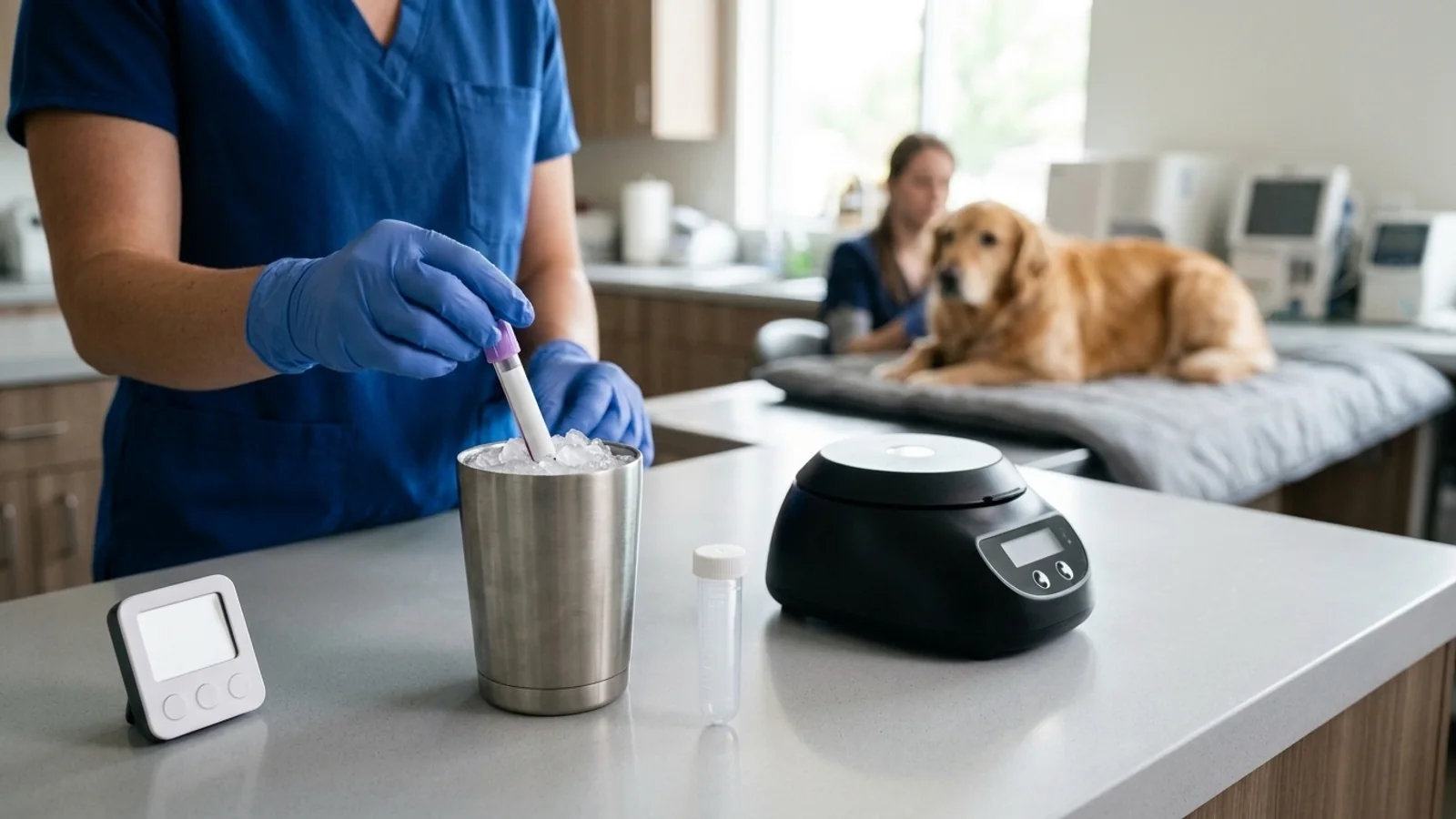
Flow cytometry characterizes cell populations by physical properties and protein expression, providing immunophenotype information. Its dependence on living cells makes sample condition and delivery part of the order. CSU requests collection within 24 hours of shipping and overnight transport with a cold pack, without freezing. Preserved tissue or a dried smear cannot simply be substituted for the requested suspension. CSU specimen instructions.
Weekend acceptance is laboratory-specific. OSU’s linked 2021 submission guide specifies weekday arrivals, with a Friday cutoff before noon and no weekend acceptance. In contrast, CSU’s current FAQ allows Saturday flow processing if the shipment reaches its facility by 10 a.m., using an appropriate courier service. A Friday collection therefore requires confirmation of the destination’s actual receiving arrangements; there is no universal Monday–Thursday-only rule. OSU submission guide; CSU FAQ.
A complete blood count (CBC) is another destination-specific requirement. CSU asks for blood-flow submissions to have a CBC from within two days or a request for CSU to perform one. OSU’s guide requests a CBC less than 48 hours old, or additional blood for its laboratory to run one, and describes an added CBC charge if no report accompanies the submission. Those blood rules should not be presented as a CBC requirement for every slide, tissue or fluid submission.
The practical sequence is to check the laboratory’s acceptance window, courier delivery commitment and specimen instructions together. A booked pickup does not establish timely laboratory receipt. Record the collection time and the expected arrival, and identify who will contact the lab if transport is delayed. This is an ordering workflow for the practice; it does not require an owner to handle or package a specimen.
PARR keeps more material in consideration, with limits
PARR assesses antigen receptor gene rearrangements to help distinguish a clonal lymphoid population from a more diverse population. It does not need living cells, which keeps preserved material in consideration. That advantage does not make every old sample adequate: too little lymphoid DNA or assay inhibition can prevent an interpretable result. Avoid assigning a guaranteed usable lifespan to a tube, slide or block merely because DNA is more stable than living cells. CSU specimen instructions; MSU PARR service.
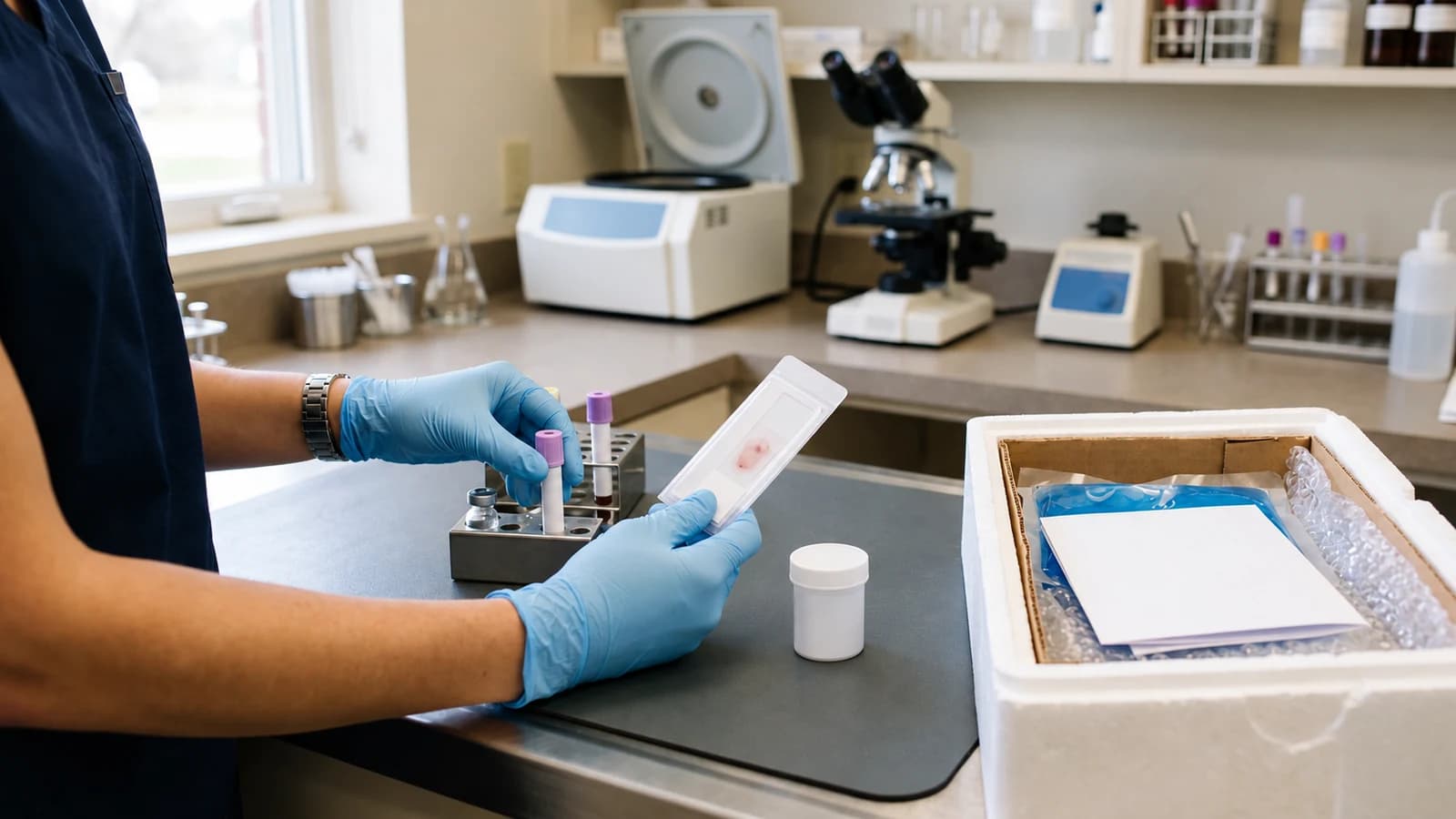
Identify the specimen precisely. An unstained tissue section cut from a biopsy block is different from an air-dried aspirate smear. A routine peripheral blood smear is different from an EDTA blood sample. CSU and Antech exclude peripheral blood smears for the PARR submissions described on their pages; their acceptance of cellular tissue smears should not be extended to every slide in the clinic. Likewise, glued coverslips are excluded by those services.
Shipping instructions also remain destination-specific. CSU states that its PARR samples do not require special shipping and may travel at the desired delivery speed. VDx nevertheless recommends protecting FFPE blocks from melting during warm-weather shipment, including an insulated ice pack. A DNA-based assay’s lack of a live-cell requirement does not remove the need to protect the physical specimen. CSU specimen instructions; VDx specimen guidance.
What each named laboratory accepts
The comparison below uses the laboratory instructions checked on October 23, 2026. OSU’s linked file is a 2021 guide, so its figures describe that document and need confirmation with OSU before a current booking. An omitted service or turnaround means this evidence does not establish it; it does not mean the laboratory lacks the service.
| Laboratory and evidence | Existing-material or PARR pathway | Flow requirements established here | Timing and routing limits |
|---|---|---|---|
| CSU CHL: submission instructions and FAQ | PARR: 4–5 cellular tissue/fluid slides; at least 500 µL EDTA blood or marrow; no peripheral blood smears or glued coverslips. FFPE: block or five 20-µm curls, with histology context. | Blood/marrow: at least 1 mL EDTA; blood CBC within two days. Organ aspirates: no-additive tube with 1 mL saline plus 0.1 mL serum. Follow CSU’s separate cavity-fluid instructions. | Flow estimate: three business days after receipt. PARR: about one week after testing starts; non-fixed samples start next business day, FFPE runs Tuesday/Thursday mornings. Saturday flow: by 10 a.m. |
| MSU VDL: PARR biopsy-service page | Routine fixed biopsy tissue and previously submitted biopsies; another pathology service can send the paraffin block. PARR is offered with biopsy or second opinion and immunophenotyping. | The cited PARR page does not establish flow requirements. | No numeric turnaround on this page. Confirm the panel, included review and timing directly. |
| OSU VMC: 2021 flow guide | The guide describes holding the flow pellet and leftover sample for up to two weeks and forwarding material for external genetic testing. | Blood: at least 0.5 mL EDTA, plus recent CBC or additional blood. Cavity fluid: at least 0.5 mL EDTA. Aspirate medium: 1 mL total, 90% saline and 10% same-species serum. | Guide: flow in 1–3 business days after receipt; weekday arrivals, before noon Friday. Confirm these dated instructions and retention availability before use. |
| Antech: PARR test page | S85503: 0.5 mL EDTA blood/marrow or specified cellular slides/fluid; generally 4–5 cellular tissue/fluid slides, with different marrow wording. Original cytology report and CSU submission form requested. | The cited PARR page does not establish flow requirements. | S85503 lists 9–11 business days and external fulfillment. FFPE uses different codes; verify the exact order described below. |
| VDx: veterinary diagnostics page | Cytology PARR Profile: preferably 10–15 unstained slides; stained accepted. Prior biopsy: FFPE block or at least ten unstained charged slides plus H&E for each block. Pathologist review is included. | The page identifies its flow service as canine only. Confirm its current collection and shipping instructions before ordering. | PARR: published 7–10 working days from receipt/order. Outside material may be consumed wholly or partly and cannot be returned. |
For Antech FFPE orders, the Antech page identifies CS86965 for the feline intestinal lymphoma panel at MSU, CS85562 for the MSU lymphoma PARR panel, and CS85503 when specifically requesting CSU FFPE PARR. Do not assume that S85503’s listed turnaround applies unchanged to those differently coded panels. Confirm the code and destination before a block is released. Antech PARR directory.
These timings are estimates from different services, rather than a head-to-head speed comparison. Receipt, test initiation, batch day and external transfer are different events. Ask when the clock begins and whether the quoted interval includes shipping and morphology review. Do not promise a treatment date from a table estimate or substitute an unverified turnaround for a blank cell.
Ask the holding laboratory before another procedure
Reuse pathways differ. CSU’s canine test-selection guidance supports PARR on its existing flow sample after an equivocal result. OSU’s dated guide describes retention and external forwarding, not an immediate in-house PARR result. MSU accepts previously submitted biopsy tissue and blocks requested from another pathology service. None of these statements guarantees that an individual case still has sufficient material available. CSU test selection; OSU retention guidance; MSU biopsy reuse.
Have the original laboratory case number, report, specimen site and collection date available for that conversation. State the unanswered question rather than asking only for “another lymphoma test.” The pathologist can then assess whether the remaining sample addresses clonality, immunophenotype or a question that still requires tissue architecture. An add-on request should identify both the material and the intended interpretation.
Ask what remains: original smears, a residual fluid sample, a stored cell pellet, a biopsy block or sections. Confirm which of these is actually available for the proposed assay.
Ask who authorizes the add-on or external transfer, which reports and forms must accompany it, and whether the original laboratory or practice arranges shipment.
Ask about the retention deadline, expected reporting interval and any limits caused by the remaining quantity. Do not treat OSU’s published “up to two weeks” as a guaranteed holding period elsewhere.
Before releasing irreplaceable material, ask what will be consumed, what can be retained for further review, and whether the receiving pathologist needs the block or selected slides.
VDx explicitly warns that material received from another laboratory can be consumed in whole or in part and cannot be returned. Confirm what will be used before sending the only remaining specimen. This is especially relevant when both a second interpretation and molecular testing are planned. VDx material policy.
An owner can ask the veterinary team to check retained material before arranging another visit. If transfer or review is needed, the guide to a second pathology opinion explains the broader request. If the initial problem was an inadequate aspirate, the nondiagnostic cytology guide covers that earlier discussion. Neither a transfer nor PARR automatically resolves a sample-quality problem.
Species and sample site can change the choice
For dogs, CSU generally favors flow immunophenotyping because it can provide diagnostic and prognostic information; some lymphomas still require histology for subtype assessment. Existing slides may make PARR feasible without making it equivalent to the information a fresh flow sample would provide. Ask which information would affect this patient’s next decision.
Cats need a separate assessment. CSU describes a role for flow in feline lymphocytosis, with many cases requiring follow-up PARR, while PARR or histology with additional testing can be more useful in solid-organ disease. For suspected feline gastrointestinal lymphoma, its guidance names intestinal aspirate or biopsy material and reports that about half of mesenteric nodes from cats with confirmed PARR-positive intestinal lymphoma test negative. That observation is not a universal false-negative rate for every feline PARR assay. It explains why a convenient retained node sample may not answer an intestinal question. CSU species and site guidance.
CSU also directs plasma-cell neoplasia questions toward PARR because its flow service lacks antibodies to identify plasma cells. That is a limitation of the named laboratory’s testing, not proof that all veterinary flow laboratories have identical panels. The ordering discussion should specify the suspected cell population and available assay.
The broader canine lymphoma workup and feline lymphoma guide address disease assessment and care decisions. Here, the narrower task is determining whether the available specimen can supply the missing diagnostic information.
Why eligible material may still be inconclusive
CSU estimates minimums of about 50,000 lymphocytes for PARR and 350,000 for flow. These are its feasibility estimates, not universal rejection thresholds or guarantees of a result. A low-yield specimen does not become diagnostic simply because PARR needs fewer cells. Ask whether the report describes inadequate material, a biologically ambiguous population, or another limitation that affects the proposed next test. CSU adequacy estimates.
The same FAQ permits combining peripheral lymph-node samples for flow but excludes combining different tissues; it strongly discourages pooling PARR samples because a less affected sample can dilute the neoplastic population. Keep specimen sites identified and seek laboratory advice before combining retained material. CSU’s submission page also notes that PCR inhibition can occur, including with mast cells; that does not establish a specific inhibition mechanism or a guaranteed rescue method.
Published performance also belongs to a specific assay and sample group. Ehrhart and colleagues’ 2019 canine ePARR study reported 100% sensitivity (19/19) and specificity (18/18) in the evaluable air-dried aspirate cohort, but four of the original 41 samples failed control-primer quality checks. For other evaluable groups, lymphoma-detection sensitivity was 92% for FFPE and 85% for flow pellets; T-cell classification sensitivity in pellets was 64%. These were different specimen cohorts, not paired evidence that an old slide always outperforms a fresh sample. They cannot be transferred to cats or every commercial PARR assay. Ehrhart et al., 2019.
MSU explicitly requires morphology and immunophenotyping alongside its PARR service. Inflammatory lymphoid expansions can occasionally produce clonal patterns, so a clonal result needs clinical and morphologic interpretation. A negative or polyclonal result does not exclude lymphoma. The useful endpoint is a veterinarian and pathologist deciding what the combined evidence answers, what remains uncertain, and whether another specimen would add information. Suitable retained material may avoid another collection; it cannot guarantee diagnostic certainty. MSU interpretation policy; CSU test-selection limits; VDx interpretation limits.