Cat Blood Typing: Why Matching Matters Before a Transfusion
Understand why cats need blood typing before a transfusion, what a crossmatch adds, and how to keep results and prior-transfusion records for future care.

Why the team checks blood type before a transfusion
If your cat is anemic and the team is considering a transfusion, the blood-type test answers a safety question: which feline AB group does your cat belong to? It does not tell the team how severe the anemia is or whether a transfusion is needed. Those decisions come from assessing the patient. Merck’s professional guidance calls AB typing essential before feline transfusions and recommends typing both donors and recipients. Sources: Merck: professional transfusion guidance.
The letters resemble human blood-group names, but the feline AB system is a different system. A routine result is A, B or AB, based on markers called antigens on red blood cells. The owner’s useful next step is to obtain the written result and ask what additional compatibility testing the hospital plans. Understanding these two tests helps you follow the discussion without trying to interpret a kit or choose a donor yourself. Sources: Merck: feline blood groups; Barfield and Adamantos (2011).
Why a mismatched first transfusion can be dangerous
Type A and B kittens develop naturally occurring antibodies during their first months of life; a previous transfusion is not required. These antibodies can recognize foreign red cells and cause their destruction, called hemolysis. Type B cats generally have strong anti-A antibodies. Anti-B antibodies in type A cats are usually weaker and are not detectable in every individual. Type AB cats lack naturally occurring anti-A and anti-B antibodies, but that does not establish compatibility with every donor. Sources: Pet Blood Bank UK: feline typing; International Cat Care: blood incompatibility.
The direction of an AB mismatch matters. Cornell eClinpath summarizes red-cell survival figures from the veterinary literature as follows. These are half-lives of transfused cells, not predictions of how long a sick cat will live or how long one transfusion will help. Sources: Cornell eClinpath: blood types.
| Situation in the cited summaries | Reported red-cell half-life | Meaning |
|---|---|---|
| Type-matched feline transfusion | 29–39 days | A comparison for donor-cell survival; patient disease can affect the clinical response. |
| Type A red cells in a type B cat | Mean 1.3 hours | Rapid destruction can produce a severe or fatal reaction. |
| Type B red cells in a type A cat | Mean 2.1 days | Usually less acute, but donor cells still have markedly shortened survival. |
Pet Blood Bank UK warns that even 1 mL of incompatible type A blood can cause a fatal reaction in a type B cat. This is a warning about mismatch severity, not a safe-volume threshold. “Only a small amount” does not make an incompatible transfusion safe. Sources: Pet Blood Bank UK: feline typing.
Typing and compatibility testing reduce specific risks; they do not remove every transfusion complication. Merck describes possible reactions including fever, breathing difficulty and circulatory shock, and recommends monitoring during and after transfusion. If you notice a change while your cat is receiving hospital care, alert the team immediately. A blood-type record supports that care but cannot replace monitoring. Sources: Merck: professional transfusion guidance.
Breed and location change the odds, not the need to test
Type A is most common overall, but population averages do not identify an individual cat. Published surveys differ by breed, region, sampling and testing method. The table separates reported type A frequencies from type B frequencies rather than treating every cat that is not A as B: type AB also exists. Figures from different surveys should not be combined into one distribution. Sources: Spada et al. (2020); Cornell eClinpath: blood types.
| Population or breed in the cited sources | Reported finding | Context |
|---|---|---|
| US domestic shorthair and longhair cats | 94–99% type A | Country-level summary in Cornell eClinpath, not a current local census. |
| UK and Australian domestic shorthair and longhair cats | 87% and 73% type A, respectively | Cornell’s survey summaries illustrate differences between populations. |
| Lombardy, northern Italy | 91.0% A; 5.2% B; 3.8% AB | 233 non-pedigree cats in Spada et al. (2020). |
| Sicily, southern Italy | 77.2% A; 12.1% B; 10.7% AB | 215 non-pedigree cats in the same study. |
| Abyssinian, Birman, Himalayan, Persian, Somali, Sphynx and Scottish Fold | 11–20% type B | Breed range summarized by Cornell; individual results require testing. |
| Exotic and British Shorthair; Cornish and Devon Rex | 20–45% type B | Reported breed range, not a worldwide registry estimate. |
| Siamese and related breeds, Burmese, Tonkinese and Russian Blue | No type B reported in Cornell’s summarized surveys | Absence in those surveys does not justify assuming an individual result. |
Spada and colleagues also describe earlier UK studies with type B frequencies ranging from 7.9% in northern to 30.5% in southern populations. Their own Italian data show why a national average can conceal a regional difference. These observations help explain blood-bank planning; they do not provide a shortcut for deciding your cat’s type. Sources: Spada et al. (2020).
Blood group is inherited, and the cited references agree that A is dominant over B. Their explanations of AB inheritance differ: the 2011 review describes a third allele, whereas Cornell’s reference notes unresolved inheritance. This guide does not choose between those models. A routine blood-type result describes the red-cell phenotype; an A result alone does not establish that a cat has two A alleles. Sources: Barfield and Adamantos (2011); Cornell eClinpath: blood types.
How clinics and reference laboratories test blood type
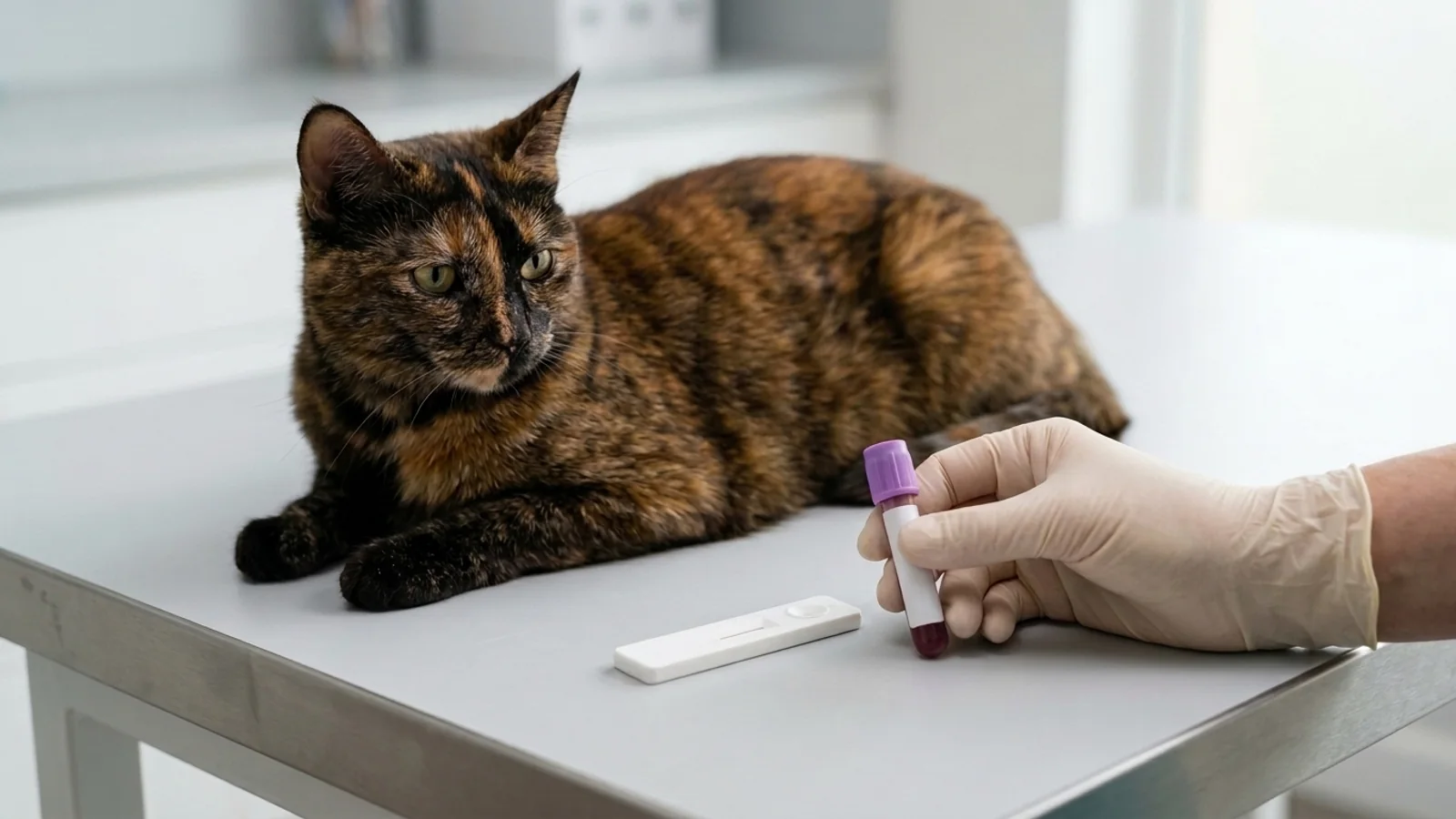
Blood typing uses a collected blood sample, commonly EDTA whole blood in a purple-top tube. The test uses reagents that react with feline A or B red-cell markers. In-clinic cards and cartridges can provide a rapid result; an external laboratory can help with confirmation. The method and result should be recorded together because an unclear result needs interpretation in the context of the assay used. Sources: Barfield and Adamantos (2011); Cornell AHDC: blood typing.
| Testing option | What the retained sources establish | What to ask the clinic |
|---|---|---|
| In-clinic immunochromatographic cartridge | Pet Blood Bank UK says the Alvedia QuickTest produces a result within five minutes. | Which kit was used, and was its result valid and clear? |
| In-clinic agglutination card | The team observes reactions with typing reagents. Some AB results can be difficult to interpret. | Does this result need confirmation with another method or a laboratory? |
| Reference laboratory | Tube agglutination is described as a reference method in the peer-reviewed literature. Cornell publishes submission requirements. | Which laboratory and method will be used, and when should the report arrive? |
The five-minute estimate belongs to the named in-clinic kit. It is not a promise that an entire appointment, emergency workup or every typing method takes five minutes. Sample collection, an unclear result or the need for further testing can change the practical timeline. Ask the team what is already complete and what information they still need. Sources: Pet Blood Bank UK: feline typing.
Cornell AHDC requests 1–3 mL of EDTA whole blood for its typing service, shipped with a cold pack for overnight delivery and not frozen. These are that laboratory’s submission requirements for veterinary staff, not instructions for an owner to collect or ship blood. The cited page does not give a reporting turnaround or specify its typing method, so it cannot support a universal 24–48-hour promise. Sources: Cornell AHDC: blood typing.
There are documented reasons to confirm an unexpected result. Spada’s review of method limitations explains that weak reactions on card tests may lead to a type AB cat being misclassified as B. The Barfield review recommends external confirmation of ambiguous card results when both A and B wells agglutinate. This caution is method-specific: it does not mean that every assay showing both A and B reactivity is invalid, because identifying AB is an intended function of typing. Sources: Spada et al. (2020); Barfield and Adamantos (2011).
Pet Blood Bank UK also summarizes a 2011 study in which some FeLV-positive cats had discordant in-house AB results and were subsequently typed as A. This is a reported testing limitation, not a way to diagnose FeLV from a typing result. Keep a corrected or confirmatory report alongside the original, and let the veterinary team explain which result it accepts. Sources: Pet Blood Bank UK: feline typing.
What an A, B or AB result cannot tell you
The Mik discovery shows why matching AB types does not settle every compatibility question. Weinstein and colleagues reported an acute hemolytic reaction in a renal-transplant recipient after an AB-matched transfusion. The recipient lacked the newly described Mik antigen and had antibodies against it. Plasma from three of 65 tested donor cats also reacted against AB-compatible cells. Those donors had no prior transfusion history. Sources: Weinstein et al. (2007).
That small study established an additional clinically important antigen; it did not measure how common Mik incompatibility is in all pet cats. More feline erythrocyte antigens, described as FEA 1–5, have since been identified. Merck notes that Mik might be the same as FEA 1. Routine commercial AB typing does not provide a full profile of these other markers. Sources: Weinstein et al. (2007); Merck: feline blood groups.
A crossmatch can reveal a detectable reaction between a specific donor and recipient that routine typing misses. It does not identify which non-AB antigen caused the reaction, or give your cat a “Mik type.” Cornell also notes that low antibody levels can escape detection and delayed hemolytic reactions can still occur. A compatible result is therefore useful evidence for a particular proposed pairing, with limits. Sources: Cornell eClinpath: crossmatching.
What a crossmatch adds before the first transfusion
A crossmatch tests donor and recipient blood components for a reaction outside the body. A major crossmatch combines donor red cells with recipient plasma or serum. A minor crossmatch checks recipient red cells against donor plasma or serum. The major test addresses antibodies in the recipient; the minor test addresses antibodies carried in the donated plasma. Sources: Cornell eClinpath: crossmatching.
Type AB cats illustrate why plasma matters. They lack naturally occurring anti-A and anti-B antibodies themselves, but antibodies in donor plasma can still pose a problem. Pet Blood Bank UK discusses different red-cell products for this situation and recommends a minor crossmatch when type A blood is considered for an AB recipient. Product choice belongs to the veterinary team; “AB” is not a blanket clearance to receive any whole-blood unit. Sources: Pet Blood Bank UK: feline typing; Pet Blood Bank UK: feline crossmatching.
Pet Blood Bank UK gives around 20 minutes for the Woodley RapidVet-H major-crossmatch kit it supplies. Other methods and hospital workflows can take different amounts of time. The team interprets the reaction and test controls; a strong major incompatibility is a reason to reject that donor under Cornell’s guidance. Sources: Pet Blood Bank UK: feline crossmatching; Cornell eClinpath: crossmatching.
Evidence on crossmatching a first feline transfusion has not been uniform. McClosky et al. (2018) retrospectively reviewed records at one US university hospital. Its known-history compatibility groups included 154 cats without a prior transfusion and 55 previously transfused cats. These were cats, not 209 transfusion events across multiple hospitals. Sources: McClosky et al. (2018).
| Finding in McClosky et al. (2018) | Result | Limit on interpretation |
|---|---|---|
| Major incompatibility with at least one tested donor | 23/154 (14.9%) without prior transfusion; 15/55 (27%) previously transfused | A detected incompatibility is not the same as an observed clinical reaction. |
| Febrile reactions with packed red cells | 10.1% without a crossmatch versus 2.5% with a crossmatch | Retrospective association; it does not prove the test caused the difference. |
| PCV response and survival | No demonstrated improvement in PCV response or survival to discharge, 30 or 60 days | Absence of demonstrated benefit does not prove crossmatching has no value. |
The same paper discusses a UK screen of 112 cats that detected no non-AB incompatibilities. Pet Blood Bank UK summarizes that study and a 2020 Knowledge Summary that judged the first-transfusion evidence weak. Geography has been proposed as one explanation, but it remains a hypothesis rather than a confirmed difference in Mik prevalence. The studies do not establish one universal incompatibility rate for an individual cat. Sources: McClosky et al. (2018); Pet Blood Bank UK: feline crossmatching.
Recommendations and research findings should be read separately. Pet Blood Bank UK recommends crossmatching every feline red-cell transfusion, including the first. Cornell’s blood-types page also recommends crossmatching even after AB typing because other groups exist, although its separate crossmatching page includes a qualification when both AB types are known. Merck recommends major crossmatching in cats regardless of previous transfusion history. These are professional recommendations, not a legal mandate or a guarantee of safety. Sources: Pet Blood Bank UK: feline crossmatching; Cornell eClinpath: blood types; Cornell eClinpath: crossmatching; Merck: professional transfusion guidance.
Repeat testing matters after transfusion. New incompatibilities were detected as early as two days in McClosky’s records. The 2011 review uses a more-than-four-day interval when discussing repeat crossmatching; Merck’s updated guidance uses more than two days after a prior transfusion. Neither interval gives owners a period during which an old result guarantees compatibility. Tell the team exactly when previous transfusions occurred and ask how that history affects today’s testing. Sources: McClosky et al. (2018); Barfield and Adamantos (2011); Merck: professional transfusion guidance.
Keep a blood-type report and a separate compatibility history
Ask for a copy of the original report rather than relying on a remembered letter. The result, method and laboratory or clinic identify what was actually tested. A crossmatch needs its own entry because it concerns a particular donor or unit at a particular time. The template below is an editorial record organizer based on those distinctions, not a laboratory report, a clinical protocol or an assurance that a unit can be used.
| Record field | What to enter from the clinical record | Why retain it |
|---|---|---|
| Cat identity | Name and identifier used by the clinic; microchip number if available. | Helps a receiving hospital match the paperwork to the correct patient. |
| Feline AB result | A, B or AB, exactly as reported; retain any uncertainty or confirmation note. | Avoids turning a provisional result into a definitive one. |
| Date of typing | The sample or test date shown on the report. | Keeps the original test and subsequent confirmation in order. |
| Method and testing facility | Kit or laboratory method, if reported; clinic or laboratory name and contact. | Lets the care team request the report and clarify an unexpected result. |
| Previous transfusions | Known dates and products as documented; write “unknown” if history is unavailable. | Alerts the team to prior exposure without assuming that missing records mean no transfusion. |
| Crossmatch history | Date, tested donor or unit identifier if supplied, major/minor test, and reported outcome. | Preserves which pairing was tested; an old compatible pairing is not a new clearance. |
| Reaction or follow-up notes | The hospital’s description and any later testing or amended result. | Communicates an important event without an owner assigning its cause. |
| Original report location | Attach or save the report and discharge summary; record the clinic contact. | Keeps the summary traceable to its original documentation. |
You can keep this summary with other veterinary records and save the original reports as files you can retrieve on your phone. If records are split between a primary clinic and a referral hospital, ask each facility for the relevant report. Copying a result into the template should preserve the clinician’s wording, including “provisional,” “inconclusive” or “confirmed.” Do not replace an unclear result with a guess based on breed or an image of a test cassette.
For a cat with a previous transfusion, put the dates prominently in the summary even if the AB letter is unchanged. A result such as “compatible on 15 March with donor X” describes that past test; it is not a standing authorization to use donor X in a later admission. Keep earlier incompatible results too, rather than deleting them after the team finds a suitable unit. Sources: International Cat Care: blood incompatibility; Cornell eClinpath: crossmatching.
These are useful questions for a planned discussion or hospital update. During urgent care, give the team the history you have and let it manage the timing of testing and stabilization. The questions are intended to clarify the plan, not to prescribe products or insist on a fixed testing window.
What is my cat’s reported A, B or AB type, and can I have the original result?
Which typing method was used, and does any uncertainty require confirmation?
What compatibility testing do you plan for this donor or unit, including if this is my cat’s first transfusion?
How does my cat’s previous transfusion or reaction history change the tests needed now?
If my cat is type AB, how does the team account for antibodies in donated plasma?
What typing, crossmatch and reaction information should be included in the discharge records for our regular clinic?
If your separate question is whether a healthy cat can enroll as a donor, see Can Your Cat Donate Blood? What Each Program Requires. That guide covers program eligibility and donation commitments. This guide concerns the recipient’s typing result, the limits of compatibility testing and the records to share when a transfusion is considered.
Why blood typing also matters before breeding
Blood typing has another use in breeding cats. Type A or AB kittens born to a type B queen can absorb maternal anti-A antibodies from colostrum, the first milk, and develop neonatal isoerythrolysis. The antibodies destroy the kittens’ red cells. A mismatched mating creates a risk; it does not mean every kitten inherits type A or that every kitten will be affected. Sources: International Cat Care: blood incompatibility; Merck: professional transfusion guidance.
International Cat Care describes kittens that appear normal at birth and then weaken or stop nursing, develop red urine or jaundice, or die suddenly after nursing. Neonatal isoerythrolysis is one cause of fading, not a diagnosis for every fading kitten. Breeding cats should be typed in advance and any prevention plan discussed with a veterinarian. A weak or unexpectedly fading newborn needs prompt veterinary assessment; this article does not provide a feeding or treatment protocol. Sources: International Cat Care: blood incompatibility.
For an owner facing a transfusion decision, the main practical task is the same: obtain the documented blood type, disclose prior transfusions and reactions, and understand what the proposed crossmatch can and cannot show. These records make the clinical conversation more precise. They support the team’s assessment without promising that a type-matched or crossmatch-compatible transfusion will be free of complications.
Sources
Blood Groups and Blood Transfusions in Cats (Cat Owners version) — Merck Veterinary Manual, owner version.
Blood Transfusions in Dogs and Cats (professional version) — Merck Veterinary Manual, professional version; updated March 2026.
Blood types - Transfusion Medicine, eClinpath — Cornell University, educational reference.
Cross-matching - Transfusion Medicine, eClinpath — Cornell University, educational reference.
Canine and Feline Blood Typing (clinical topic) — Cornell University Animal Health Diagnostic Center, submission requirements.
A Newly Recognized Blood Group in Domestic Shorthair Cats: The Mik Red Cell Antigen (Weinstein et al, 2007) — Journal of Veterinary Internal Medicine, primary study.
Prevalence of naturally occurring non-AB blood type incompatibilities in cats and influence of crossmatch on transfusion outcomes (McClosky et al, 2018) — Journal of Veterinary Internal Medicine, retrospective study.
Prevalence of Blood Types and Alloantibodies of the AB Blood Group System in Non-Pedigree Cats from Northern (Lombardy) and Southern (Sicily) Italy (Spada et al., 2020) — Animals, primary regional prevalence study.
Feline Blood Transfusions: A Pinker Shade of Pale (Barfield and Adamantos, 2011) — Journal of Feline Medicine and Surgery, clinical review.
Feline blood typing (vet professional advice) — Pet Blood Bank UK, professional guidance and kit-specific timing.
Feline cross matching (vet professional advice) — Pet Blood Bank UK, professional guidance and evidence summary.
Blood groups and blood incompatibility in cats — International Cat Care, owner guidance.